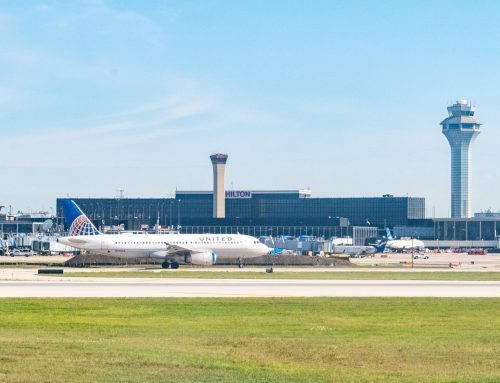

Last Friday, thousands of flights were canceled or delayed, and millions of travelers were stranded. The apparent culprit? A malfunctioning router.
It sounds like something out of Airplane!, although passengers stranded at the airport probably weren’t laughing. Fortunately, the thousands of planes already in the air landed safely. But who knows how much this incident cost in lost time and economic activity? A technician replacing aging copper lines at a facility in Arkansas appears to have inadvertently brought the nation’s air traffic control system to its knees. Not very reassuring.
Unfortunately, none of this is news. The FAA has struggled to modernize its aging air traffic control system for decades, despite billions of dollars in federal spending and repeated warnings. Just two months ago, the Government Accountability Office (GAO), Congress’ watchdog, reported that the FAA was rushing to replace aging equipment without adequate planning and coordination. GAO warned that this approach could create problems of its own, including ground stops. We can’t say we weren’t warned.
As Friday night’s debacle unfolded, Transportation Secretary Sean Duffy responded by asking Congress for $50 billion, up from the roughly $30 billion the administration had requested just days earlier. A little late to the expensive party, President Trump joined the call on Sunday, urging Congress to provide the money “FAST!”
But before Congress starts writing checks, it must take a closer look.
Just last year, Congress provided $12.5 billion for modernization, including $4.75 billion for telecommunications and related communications. That was part of the $4.7 trillion One Big Beautiful Bill Act that passed along party lines. If the FAA really needed the extra cash, that was a good time to ask. But the FAA hasn’t even provided lawmakers with a report on what it has done with that money or how it would cost effectively spend an amount more than ten times that of the telecom funds in OBBBA. Underscoring this lack of planning, GAO’s September report found serious problems with how the FAA was managing that money.
To be clear, the FAA is undertaking an enormous modernization effort, replacing decades-old telecommunications lines, radios, radars, and other equipment. That equipment keeps roughly 45,000 flights moving daily. Much of that work is long overdue, and policymakers have known about the problems for years.
In 2024, GAO found that more than three-quarters of the FAA’s 138 air traffic control systems were unsustainable or potentially unsustainable, including 58 considered critical to safety and efficiency. Some systems were more than 60 years old, and the agency was struggling to find replacement parts and technicians who even knew how to maintain them. Upgrades for some of the most critical systems were years away. For others, the FAA had no modernization plans at all.
Under the current modernization effort, the FAA had 11,389 individual project schedules but no overarching plan to coordinate that work. That meant contractors could be scheduled to visit the same facility months apart for different installations, without considering whether the work could be combined or how it might affect air traffic operations. GAO warned that these inefficiencies, combined with pressure to meet deadlines, could lead to shortcuts in testing and other critical work, increasing the risk of widespread disruptions. That pretty well describes what happened last week.
GAO also found that the FAA had waived many of its standard rules for overseeing major projects, including the requirement to develop a reliable estimate of the overhaul’s total cost. Which, as always, brings us back to the money.
The FAA estimated that the first phase of systems modernization would cost $10.6 billion. But when GAO asked for the analysis supporting that figure, agency officials couldn’t produce it. The estimate also left out the cost of FAA personnel overseeing and supporting the work, most long-term operating and maintenance expenses, and the second phase of modernization. Kind of like pricing a plane ticket without accounting for the pilot, crew, or fuel.
This isn’t the FAA’s first expensive modernization effort. Its previous NextGen initiative consumed more than $14 billion in federal spending from fiscal years 2007 through 2022, only to encounter delays and missed performance goals. GAO has repeatedly reported inadequate planning, overly-optimistic estimates, and weak contractor oversight. In other words, the FAA has been down this runway before.
Additional funding may well be necessary. After all, the aging equipment needs replacing, and the consequences of another failure could be a lot worse. But the fix can’t simply be Congress giving the FAA a $50 billion blank check. To put $50 billion into perspective, in his FY27 budget request the President asked for $22.4 billion for the ENTIRE FAA! If lawmakers approve this huge lump sum on top of the regular budget, it would be abdicating oversight over the modernization effort, rewarding failure, and buying the FAA a ticket to ignore Congress for a couple years.
GAO offered two straightforward recommendations in September. Develop a reliable estimate of the overhaul’s total cost and establish a coordinated schedule for getting the work done. The Department of Transportation only partially agreed, arguing that the FAA already had adequate planning measures in place. Womp-womp. Uh, that didn’t age well. Friday’s events seem to prove otherwise.
Those recommendations should be the starting point for congressional oversight, along with an accounting of the $12.5 billion already appropriated. The point isn’t to slow modernization. It’s to make sure the FAA can do it without creating new problems along the way.
It is very easy to react to a problem by throwing out a big round number, say $50 billion, and call it a fix. But the problem isn’t a lack of money, it’s a lack of leadership and planning. Secretary Duffy and the FAA need to show their work—where did the $4.75 billion for telecom and the rest of the $12.5 billion for modernization go? What is their plan going forward? What do they legitimately need? Until those questions are answered, no additional funding should be cleared for takeoff.