The Bureau of Land Management (BLM), under the Department of the Interior (DOI), leases parcels of federal land to private entities to develop oil and gas from the federal onshore mineral estate. In exchange for the privilege to extract resources from federal lands and sell them for private profit, operators are required to reclaim—clean up—wells and surrounding sites once production has ceased. BLM is responsible for assuring companies provide upfront bonds to ensure the inevitable reclamation is paid for by operators, not taxpayers.
Unfortunately for taxpayers, BLM has recently proposed to reduce the minimum financial assurance companies must set aside before drilling on federal lands. These laxer requirements could leave taxpayers exposed to an estimated $6.2 billion in future cleanup liabilities if operators fail to meet their reclamation obligations.
Basics of Oil and Gas Bonding
When operators drill wells on federal lands, they change the landscape. This “surface disturbance” includes road construction, topsoil excavation and leveling, drilling, installing machinery, and storing equipment and materials. BLM defines reclamation as restoring lands to a condition “equal to or closely approximating” their original state.[1] This involves plugging the well, removing structures, and reshaping and revegetating the site. If not reclaimed properly, wells can damage the environment and public health by leaking methane, contaminating surface water and groundwater, fragmenting habitats, eroding soil, and interfering with agriculture and recreation.[2]
To ensure complete and timely reclamation, the Mineral Leasing Act of 1920 requires BLM to obtain an adequate bond or other financial assurance from operators before drilling begins. BLM uses bonds to cover at least some of the costs of reclamation if operators abandon wells or otherwise fail to adequately restore the landscape. If reclamation is completed, the bond is returned to the operator.
Bonding Protects American Taxpayers
When an operating company dissolves or goes bankrupt, as they regularly do in the oil and gas boom-and-bust cycle, BLM must rely on a company’s bond to cover reclamation. If the amount of the bond is insufficient, taxpayers are forced to cover the costs.
Reclamation costs can vary widely depending on the depth and location of a well. Deeper wells are generally more expensive to reclaim, with cost typically increasing in proportion to depth. And wells in hard-to-reach locations, such as in the middle of a river, also cost more to reclaim. The Government Accountability Office (GAO) estimates reclamation costs range from $20,000 to $145,000 per well, with extreme cases as low as $3,069 and as high as $603,000.[3] The BLM estimates the cost to plug a well and reclaim the surface ranges from $35,000 to $200,000, with an average cost of $71,000.[4]
We do not know the exact amount of taxpayer dollars spent each year reclaiming orphan wells. Most recently, the Infrastructure Investment and Jobs Act (P.L. 117-58) appropriated $4.7 billion: $4.275 billion for state and private land, $250 million for federal land, and $150 million for tribal land.
Current Bonding Requirements
Currently, BLM accepts two types of bond coverage:
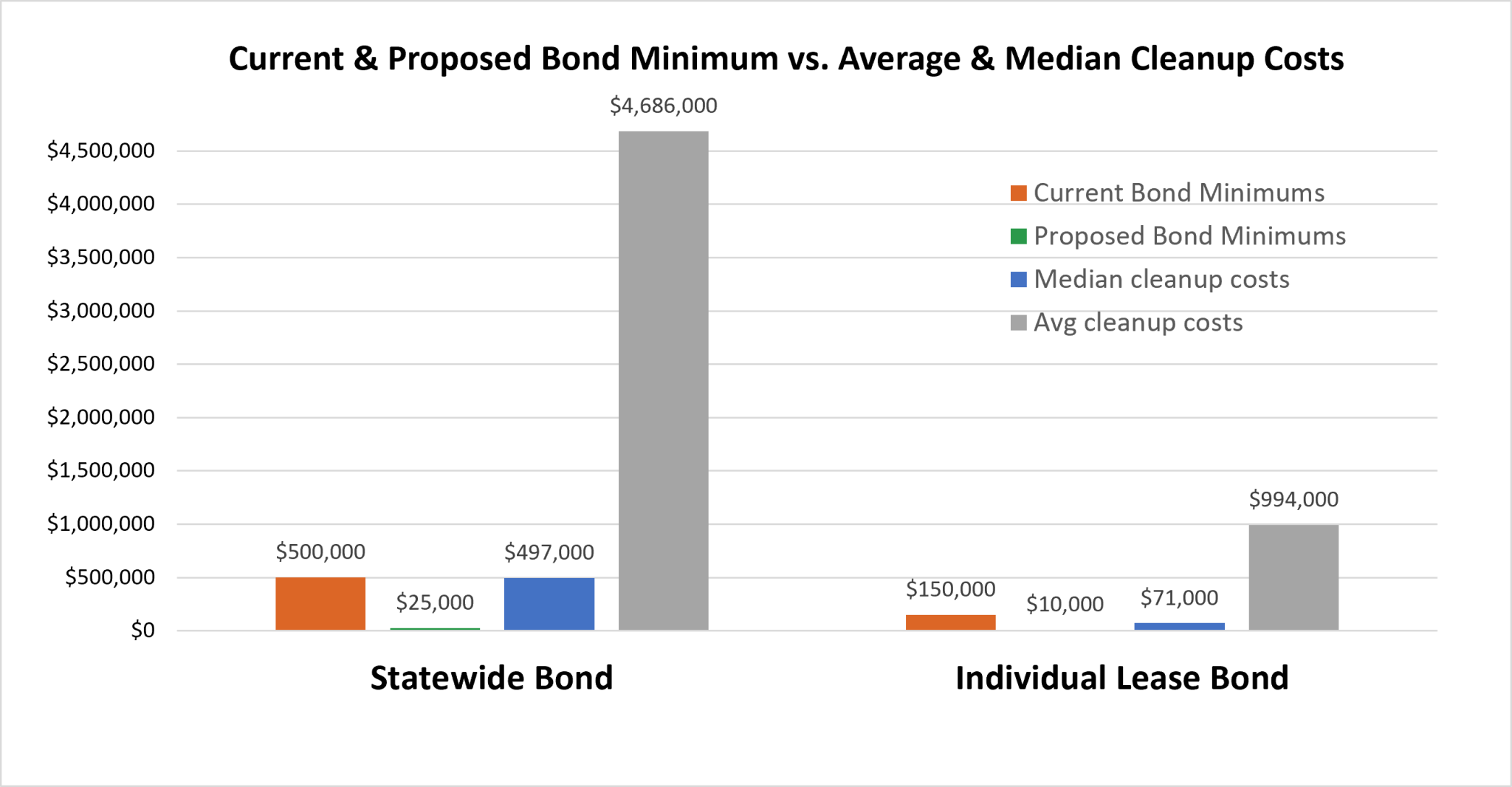
Bonds for an operator’s wells on an individual lease (minimum $150,000)
Bonds for all wells owned by an operator in one state (minimum $500,000)
Higher bond values may be required if the operator has a history of violations, BLM anticipates unusually high reclamation costs, or there are other risk factors.
Operators may provide either a surety bond or a personal bond. A surety bond is a legally binding contract with a third-party surety company that assumes responsibility for the debt if the operator defaults or cannot make bond payments. A personal bond consists of cash or other approved financial instruments pledged by the operator. Acceptable forms include certificates of deposit, letters of credit, cashier’s checks, certified checks, and negotiable Treasury securities.
When the federal government does not own the surface rights—which are separate from mineral rights and may have different owners—operators may be required to secure a surface owner protection bond. This bond does not cover reclamation costs but instead addresses other damages, such as damage to crops.
The current bonding requirements took effect in June 2024 for new leases and are being phased in for existing leases. Nationwide and unit bonds were required to be converted into statewide or individual bonds by June 2025. Statewide bonds must be increased to the new minimum by June 2026 and individual lease bonds by June 2027.
Lowering Bond Minimums Put Taxpayers at Risk Again
A proposed rule released in June 2026 could reverse updates to bonding requirements made in 2024. Prior to the 2024 updates, oil and gas bonding minimums had not been adjusted in over 60 years and failed to cover the full cost of well reclamation. Too often, taxpayers had to cover the shortfall between growing cleanup costs and outdated bond amounts.
The old bond minimums were:
$10,000 for an individual lease (set in 1960)
$25,000 for statewide coverage (set in 1951)
$150,000 for nationwide coverage (set in 1951)
The proposed rule would return minimum bond amounts to their 1950s and 60s level, reducing the minimum individual lease bond to $10,000 and the statewide bond to $25,000. Although the proposed rule did not formally reintroduce nationwide bonding, BLM is soliciting comments on whether nationwide bonds should be restored.
Before the minimums were raised, GAO found the average bond held by the BLM was $2,122 per well in 2019[5]—far below the estimated average reclamation costs of $71,000.[6] Decades of inadequate bonding left taxpayers with millions in cleanup costs for thousands of orphaned oil and gas wells on federal land. The Interstate Oil & Gas Compact Commission estimated there were at least 15,913 known orphan wells on federal and tribal land at the end of 2021, with many more undocumented.[7]
In 2023, the last year under the outdated bond minimums, BLM reported that the agency held approximately 1,500 bonds covering 110,000 existing wells nationwide and totaling around $425 million. [8] That amounted to average bond coverage of just $3,873, or about 5 percent of the estimated reclamation cost of $71,000 per well.[9] If the current bond minimums were rolled back and average bond coverage again fell to roughly $3,873 per well, the federal government would hold about $356 million in financial assurances for the 91,935 wells currently producing on federal lands. Reclaiming those wells at the end of their productive lives would cost roughly $6.5 billion in today’s dollars, leaving taxpayers exposed to approximately $6.2 billion in future cleanup liabilities.
*TCS calculated the average and median cleanup costs for statewide bond and individual lease bonds based on the average and median number of wells that are covered by a statewide and individual lease bond, as reported by the Department of the Interior in 2023. TCS used the average cleanup cost of $71,000 for this estimate.
The previous bonding requirements failed to protect taxpayers for several reasons:
Old bonding minimums had never been adjusted for inflation since they were first set in the 1950s and 1960s. Adjusted for inflation, the original $10,000 minimum for an individual lease bond set in 1960 would equal $108,765 in Likewise, the original statewide and nationwide bond minimums set in 1951 would translate to $309,561 and $1,857,363 in reclamation coverage.
Wells have become substantially deeper and more expensive to reclaim. Average well depth increased from roughly 3,700 feet in 1950 to more than 6,000 feet in 2008, with some wells drilled to 10,000 feet.[10]
Bonding requirements do not account for the number of wells on a lease(s). Minimum bond values are based on broad categories rather than the number of wells covered, favoring operators with large numbers of wells. For example, an operator with 10 wells in a state paid the same $25,000 statewide bond as one with 100 wells. Bond minimums also failed to consider other well characteristics, such as depth and location, that directly affect reclamation costs.
The BLM frequently accepts bonds at the regulatory minimum, despite having the authority to require higher amounts. Although the agency could raise bond values above the statutory minimum—and was required to do so if an operator had previously failed to reclaim a well—82% of all bonds were still set at the regulatory minimum.[11]
Conclusion
Federal lands are entrusted to operators for responsible oil and gas development, but unreclaimed wells pose serious environmental, public health, and financial risks. For decades, weak bonding requirements allowed operators to abandon wells with little consequence while passing reclamation costs onto taxpayers.
The proposed rollback would once again leave taxpayers exposed to an estimated $6.2 billion in future cleanup liabilities if operators fail to meet their reclamation obligations.
[1] Bureau of Land Management (BLM), “Oil and Gas Site Reclamation,” accessed July 2024, https://www.blm.gov/programs/energy-and-minerals/oil-and-gas/reclamation.
[2] Government Accountability Office (GAO), “Oil and Gas: Bureau of Land Management Should Address Risks from Insufficient Bonds to Reclaim Wells”, September 2019, https://www.gao.gov/products/gao-19-615.
[4] BLM, “Fluid Mineral Leases and Leasing Process,” Federal Register, July 2023. https://www.federalregister.gov/documents/2023/07/24/2023-14287/fluid-mineral-leases-and-leasing-process#p-82
[5] GAO, “Oil and Gas: Bureau of Land Management Should Address Risks from Insufficient Bonds to Reclaim Wells”, September 2019, https://www.gao.gov/products/gao-19-615.
[6] BLM, “Fluid Mineral Leases and Leasing Process,” Federal Register, July 2023, https://www.federalregister.gov/documents/2023/07/24/2023-14287/fluid-mineral-leases-and-leasing-process#p-82.
[7] Interstate Oil & Gas Compact Commission, “Idle and Orphan Oil and Gas Wells: State and Provincial Regulatory Strategies 2021,” https://iogcc.ok.gov/sites/g/files/gmc836/f/iogcc_idle_and_orphan_wells_2021_final_web.pdf.
[8] BLM, “Fluid Mineral Leases and Leasing Process,” Federal Register, July 2023, https://www.federalregister.gov/documents/2023/07/24/2023-14287/fluid-mineral-leases-and-leasing-process#p-82.
[10] GAO, “Oil and Gas: Bureau of Land Management Should Address Risks from Insufficient Bonds to Reclaim Wells”, September 2019, https://www.gao.gov/products/gao-19-615.