It’s an election year. For the majority of House and Senate members seeking reelection, 2026 is essentially an extended on-the-job interview. They have until November 3rd to show they are up to the job they are applying for. But whether you’re running for reelection, for higher office, or for the hills, taxpayers need lawmakers to perform in their current job. Washington has a lot on its to-do list for 2026. Front and center should be getting to regular order on the 2027 budget to help Make Congress Great Again.
First, lawmakers need to finish last year’s work. Three full months into the 2026 fiscal year and the vast majority of government is running on a stop-gap through January 30th. Lawmakers seem poised to pass another three-bill minibus, but that leaves six bills, including the costliest (Defense) and typically most contentious (Labor/HHS and Homeland Security). Three weeks is plenty of time to find agreement. It also allows the country to avoid another government shutdown, another short-term continuing resolution, or, worse, a full-year CR that mostly locks agencies into spending decisions made over a couple years ago (since in FY25 all of government operated under a full year CR at FY24 spending levels). Give us an example of working under pressure and how you handled it.
They must handle it, because taxpayers need lawmakers to move on to the fiscal year 2027 budget. You can’t really be expected to work on next year’s budget if you are still handling this year’s. By law, the presidential budget request is supposed to be submitted to Congress by the first Monday in February. Under “regular order” the House and Senate would then agree on a Budget Resolution, setting the total spending levels for the government, by April 1. That total is then divided among the appropriations subcommittees to draft each of the twelve spending bills. Bills can be drafted, debated, and voted on by September 30.
The last time each appropriations bill was passed individually and on time (instead of as a combined package or after September 30) was 1994. Regular order may be a stretch, but demonstrating growth from last year is not.
The most recent budget resolution adopted by Congress provided wildly different fiscal recipes to each chamber. It directed House committees to find $2 trillion (with a “t”) in spending cuts to partially offset a $300 billion increase in defense/border spending and the $4.5 trillion price tag for reauthorizing the expiring 2017 tax cuts. The same resolution allowed Senate committees to increase spending by $500 billion while including a mere $4 billion (with a “b”) in spending reductions. Even worse, Senate Republicans ignored the cost of reviving expired tax cuts and provided themselves $1.5 trillion in deficit increases for new tax breaks. These two different menus ultimately led to the One Big Beautiful Bill Act legislative stew that CBO projects bakes in a $3.3 trillion increase in federal deficits.
Lawmakers need to move toward a fiscally responsible, regular budget and spending process because our nation’s finances are dire. Federal debt stands at $38.4 trillion. The fiscal year 2025 deficit hit $1.8 trillion and projected to rise. The debt ceiling, increased to $41.1 trillion by OBBBA, is fast approaching. And the biggest drivers of federal spending, Social Security and healthcare, need to be strengthened.
Lawmakers in 2026 are going to face a host of fiscally fraught issues challenging Congress’s power of the purse. Even as the legality of the tariffs plays out in court, the administration is banking on tariff revenues to pay for new tax and spending promises, the most recent a $500 billion requested increase in defense spending for fiscal year 2027 (despite the tariffs only yielding an additional $288 billion on annualized basis). Instead of revenue, there may be tariff rebates and continued economic disruption. The strike in Venezuela may be just the first in a series of open-ended military conflicts and could lead to open-ended budget blackholes like the Overseas Contingency Operations account. USDA’s tapping the CCC Charter act to send subsidies to farmers, the apparent push to reduce or dismantle FEMA, and the administration’s suspension of grant funds to states all foreshadow a continuance of 2025 where the administration used DOGE, impoundments, pocket recissions, and other tools to undermine congressional authority over the nation’s pocketbook.
Funding the government is one of the few tasks the legislative branch is constitutionally obligated to undertake. It’s also one of the cleanest and clearest ways for elected members to put their promises into action. The fiscal year 2027 Budget Resolution and spending process should be the easy part. So, those of you vying for the job of Representative or Senator, are you willing to Make Congress and fiscal responsibility Great Again? Then stop telling and start showing.
PS: Weekly Wastebasket readers, the winner of the end of year poll for best title is Pain in the Tongass. Read here for an update on this issue.
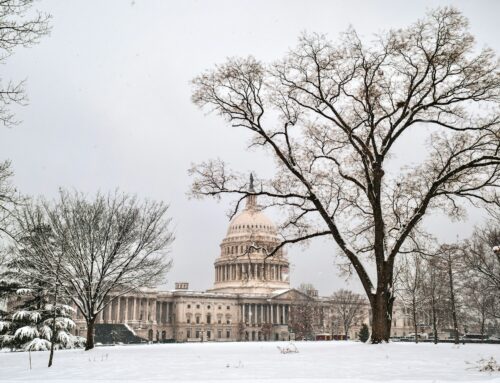
- Photo by Connor Gan on Unsplash