
At the end of last week, the President signed into law a three-bill minibus covering Commerce, Justice, Science; Energy and Water Development; and Interior and Environment. The bill provides appropriations for key federal wildfire programs housed within the U.S. Forest Service (USFS) and the Department of the Interior (DOI).
The USFS and DOI Wildland Fire Management (WFM) accounts oversee the majority of expenditures for wildfire response activities on federal lands, including firefighter salaries and equipment. The DOI WFM account also contains appropriations for research through the Joint Fire Science Program, mitigation through hazardous fuels management, and recovery through burned area recovery, while comparable USFS line items are funded through other offices. In addition, the USFS administers two grant programs— State Fire Capacity and Volunteer Fire Capacity—aimed at building state and local capacity to address wildfires.
Select U.S. Forest Service and Department of the Interior Annual Appropriations ($, thousands)
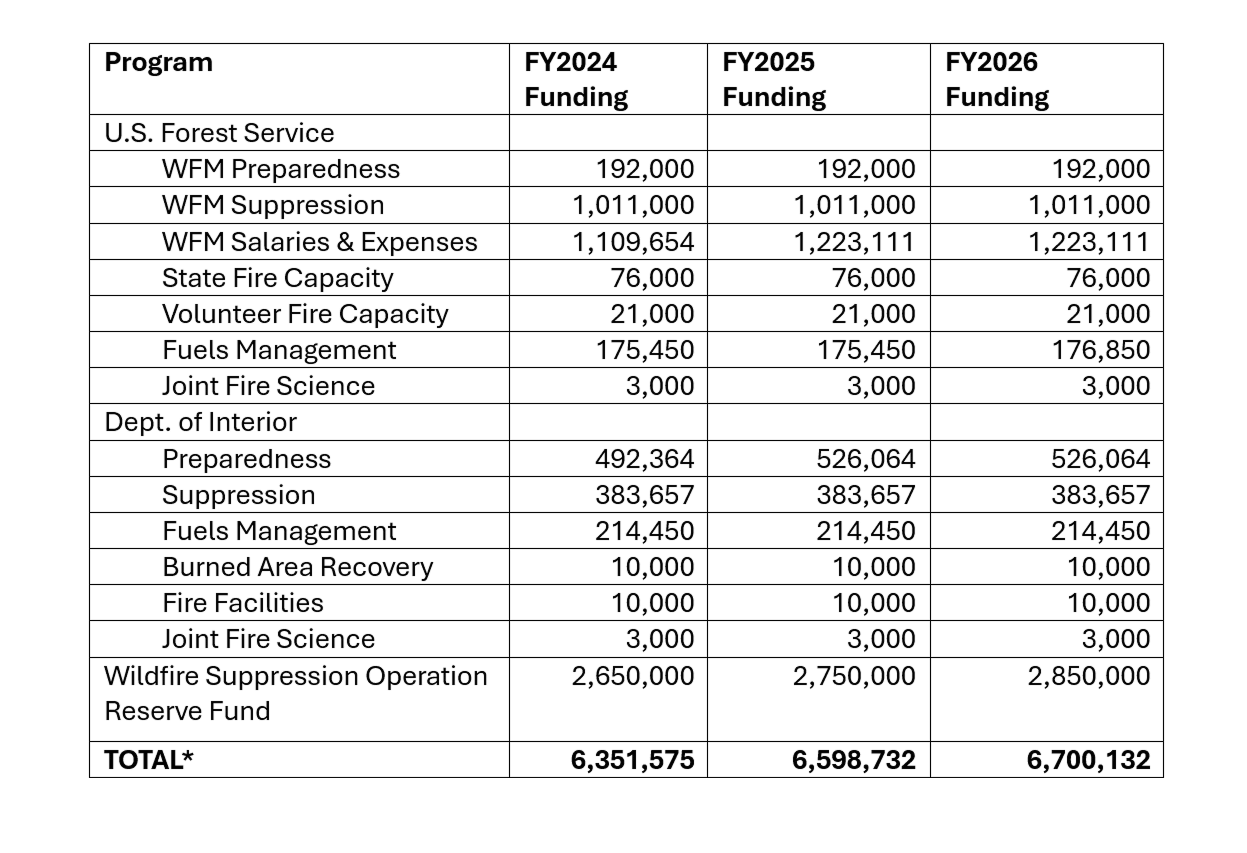
*In addition to annual appropriations, USFS and DOI have received millions in supplemental appropriations from the Infrastructure Investment and Jobs Act (IIJA) FY2024-2-26. More details on this supplemental funding and historic wildfire spending are available in our Federal Wildfire Spending Database.
With the exception of slight increases in the USFS Hazardous Fuels account, federal wildfire programs were funded at roughly the same levels as last year:
- Funding for the USFS WFM Salaries & Expenses and DOI WFM Preparedness accounts—a sustained increase from FY2024 levels—reflects the permanent pay increase for wildland firefighters enacted in March 2025 and carried forward into FY2026.
- Funding for the USFS and DOI Suppression accounts at $1.01 billion and $383.7 million, respectively, is required to access the Wildfire Suppression Operation Reserve Fund.
- The Wildfire Suppression Operation Reserve Fund, which provides additional federal funds for urgent wildfire suppression activities, is funded at the statutory cap of $2.85 billion. Under current law, the cap increases by $100 million each fiscal year until the fund expires at the end of FY2027. As that expiration approaches, Congress has an opportunity to reevaluate how wildfire suppression activities are funded moving forward.
- The bill also directs the Secretary of Agriculture and the Secretary of the Interior to hire an independent, nonpartisan research organization with expertise in federal land management to conduct a comprehensive study on the impacts of consolidating wildfire programs under a U.S. Wildland Fire Service, as proposed in the President’s FY2025 budget request.
We need to improve federal wildfire spending and programs. As wildfires grow more frequent and costly, it is clear that the status quo is not working. More sustained investments in mitigation and more accurate appropriations for suppression and recovery would reduce reliance on mid-year emergency supplemental spending bills and better protect taxpayers.