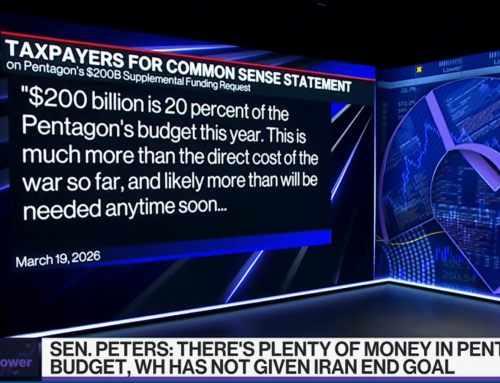

Just when you thought Pentagon spending couldn’t get more out of control, President Trump proposes a 50% budget increase in one year—rocketing Defense spending from $901 billion to $1.5 trillion. That’s $500 billion more… and tariffs won’t cover it. On Budget Watchdog All Federal, host Steve Ellis and TCS policy analyst Gabe Murphy break down why this “dream military” proposal is fiscal madness, explore a new executive order targeting defense contractor stock buybacks, and examine why Congress should have a say before military action in Venezuela costs taxpayers even more. The first episode of 2026 pulls no punches on defending your tax dollars.
Transcript
announcer (00:02):
Welcome to Budget Watchdog, All Federal, the podcast dedicated to making sense of the budget, spending, and tax issues facing the nation. Cut through the partisan rhetoric and talking points for the facts about what’s being talked about, bandied about, and pushed to Washington. Brought to you by taxpayers for common sense. And now the host of Budget Watchdog, AF. TCS President Steve Ellis.
Steve Ellis (00:40):
Welcome to all American taxpayers seeking common sense. You’ve made it to the right place. For 30 years, TCS, that’s taxpayers for common sense, has served as an independent nonpartisan budget watchdog group based in Washington, DC. We believe in fiscal policy for America that is based on facts. We believe in transparency and accountability because no matter where you are in the political spectrum, no one wants to see their tax dollars wasted. It’s January 2026, and dear podcast listeners, just when you thought the Pentagon spending couldn’t get any more out of control, President Trump has proposed increasing the Defense Department budget to $1.5 trillion for fiscal year 2027. That’s right, $1.5 trillion with a T. To put that into perspective, Congress just approved $901 billion for fiscal year 2026. The president is calling for a jaw-dropping more than 50% increase in just one year to build what he’s calling a dream military.
(01:42):
Now, we’re over $38 trillion in debt as a nation. Congress already gave the Pentagon a massive boost of $175 billion in last year’s reconciliation bill, rocketing the Pentagon fiscal year 2026 budget to over a trillion dollars for the first time in history. And that apparently was not enough. Here to break down what this proposal means for taxpayers and why it’s completely untenable is TCS policy analyst, Gabe Murphy, who’s been tracking Pentagon spending closely and working diligently on behalf of taxpayers. Gabe, happy new year and welcome back to the show.
Gabe Murphy (02:16):
Thanks, Steve. It’s great to be back and it’s been an eventful 2026 already, so I’ve got some more to report on top of this budget proposal.
Steve Ellis (02:25):
Great. And happy new year to all the budget watchdog AF Faithful out there. So let’s start with what I led with, Gabe. The issue with the most obvious taxpayer implications. The president’s proposed 50% increase. That’s right. 50, five, zero, not 15, to the Pentagon budget. What was your first thought when this came across your desk?
Gabe Murphy (02:46):
Well, Steve, to set the stage for our listeners and take you behind the scenes a little bit in the TCS office, I’d like you to imagine me at my desk mulling over the letters we sent earlier that day to the House and Senate on congressional war powers, which we’ll get to soon. As I came across this news, if I’d been drinking coffee, I would’ve spatted out all over my desktop. I mean, within seconds, I stood up and walked into your office, suggested we issue a press statement, and you wisely suggested we make sure the news was real.
Steve Ellis (03:13):
Right. I mean, as I read the president’s post on Truth Social with its talk of a dream military at the price of one and a half trillion dollars, it seemed plausibly satirical.
Gabe Murphy (03:24):
If wishing made it so, but after quickly confirming its authenticity, we got to work on a short initial response, which was covered in the USA Today and Defense Scoop and a handful of other outlets. But bottom line, Congress is already poised to enact a more than 13% increase to the Pentagon budget for FY26, an increase we strongly opposed as unnecessary and wasteful. That increase comes on the heels of a quarter century of increases, which collectively saw the Pentagon budget rise by nearly 50% adjusted for inflation.
Steve Ellis (03:54):
Gabe, that’s 50% over 25 years, not 50% in one year.
Gabe Murphy (03:59):
Exactly. I mean, that gives you a sense of just how dramatic a proposal this is. And we’ve long argued that boosting military spending is not a strategy onto itself and that ensuring our ability to budget for national security in the long term requires us to exercise fiscal restraint and make strategic decisions about what spending is truly necessary to defend the nation. In fact, we believe that with targeted cuts to wasteful programs and spending practices, some of which we laid out in detail early last year, we can actually cut the Pentagon budget and strengthen national security in the process.
Steve Ellis (04:32):
Right. As we’ve said before, spending more won’t necessarily make us safer, but spending smarter will make us stronger, and that more is not a strategy. So you could imagine our shock to learn that the president plans to balloon the Pentagon budget by 50% in one year on the heels of a 13% increase this year. Gabe, help budget watchdog AF Faithful put this into perspective. Fiscal year 2025 has not been finalized yet. Side note, listeners will recall that after the longest government shutdown in history, lawmakers passed a CR in November that reopened government until January 30th, the CR continuing resolution. We’re mere three weeks away from the expiration of that CR and all we have so far is that yesterday, House lawmakers passed a mini bus of three of the nine remaining bills to fund government. So there’s a lot of work to be done, especially since the Pentagon spending bill and the always controversial labor, health and human services and homeland security bills are still on the to- do list.
(05:36):
But I digress. Back to perspective. The entire non-defense discretionary spending in fiscal year 2024, the last year we have full numbers for, depending on how you calculate, was roughly $800 billion.
Gabe Murphy (05:51):
Right. That $500 billion increase represents roughly two thirds of the entire discretionary budget outside of the Pentagon. That’s Homeland Security, Department of Labor, education, interior, agencies like the Park Service, NASA, IRS, just about everything else.
Steve Ellis (06:09):
And to be clear, Social Security, Medicare, Medicaid are the big budget dogs, but that’s mandatory spending.
Gabe Murphy (06:14):
Yeah. I mean, put another way, giving the Pentagon an additional $500 billion would equate to an additional 1.4 billion being spent every day of the year.
Steve Ellis (06:24):
And that’s just the additional amount, not the baseline. So that’s staggering. What’s more is there’s no there there. Dream military is not a plan to spend $1.5 trillion.
Gabe Murphy (06:35):
But wait, Steve, there’s still more to unpack here. The President’s announcement did make the case that this increase will be paid for with tariff revenue.
Steve Ellis (06:42):
Of course he did. Bless President Trump’s heart. Now I know the answer, but can you tell our listeners whether there’s any truth to that claim that tariff revenue will pay for the $500 billion bulge?
Gabe Murphy (06:54):
Sure. There’s no truth to that claim. While it’s true that tariff revenue could be used to help offset any form of spending increases, and across the board problem with relying on tariff revenue is that it’s subject to change as the past year amply demonstrated. Obviously, a shift in policy under future administrations could also significantly change the calculus.
Steve Ellis (07:15):
That’s right. But even if you assume that all the tariff revenue currently projected will bear out, the math still doesn’t math. We reviewed 2025 tariff revenues versus 2026, and even after the current tariffs fully kicked in in the summer and the fall, the monthly year-on-year increase was at most $24 billion a month from previous levels. Underscoring our math, the Congressional Budget Office recently estimated current tariffs accounting for interest would raise about $3 trillion in total over the next decade. So CBO’s math comports with ours. Extrapolating $24 billion a month to a full year is 288 billion, $3 trillion over 10 years is $300 billion a year. So even if all the additional tariff revenue was directed to the Pentagon, it still wouldn’t cover the $500 billion increase. But as Bejit Washdog AF faithful know, President Trump has promised tariff revenue will pay down the debt, send $2,000 checks to Americans, bail out farmers impacted by the trade war, and on and on.
Gabe Murphy (08:19):
And yet another wrench in the math is that the Supreme Court may soon issue a ruling on whether or not a large portion of the tariffs are actually legal. I won’t get too far into the weeds on this, but one of the possible outcomes is that the US has to reimburse some importers who have already paid duties on tariff products. If that happens, tariff revenue over the next decade would plummet.
Steve Ellis (08:40):
Gabe, part of the point of tariffs is to get other countries to negotiate and reduce their barriers and also to foster domestic production, both of which would reduce future tariff revenue.
Gabe Murphy (08:51):
Right. So anyway you slice it, tariffs won’t be able to cover the cost of this radical proposal. That means if it happens, it will be financed with more debt. The committee for a responsible federal budget broke down these numbers and found that accounting for interest, this proposal would add $5.8 trillion to the national debt over the next decade. And as you said in your statement yesterday, Steve, Congress must repudiate this nonsense and oppose this massive unaffordable and counterproductive increase to the Pentagon budget.
Steve Ellis (09:23):
And to paraphrase the committee for responsible federal budgets estimate, I mean, part of it is, is because you’ve now reset the baseline. And so they’re assuming that they’re not going to cut the Pentagon back down to a trillion or anywhere close to it. They’re going to keep increasing as they have in previous years and as Gabe pointed out over the previous quarter century. So rest assured BudgetWash Aug AFA full, we’ll be pushing Congress hard to stop this proposal in its tracks and not have this dramatic increase in Pentagon spending. All right, because it’s a new year, and I want to be hopeful, let’s turn to something a bit more encouraging. Last month, the president teased the idea of an executive order to limit Pentagon contractors from issuing dividends to shareholders or buying back their own stock when they are over budget and behind schedule on military contracts.
(10:13):
We put out analysis supporting this idea earlier this week and later that day, poof, the executive order came out, didn’t know we had that power. Gabe, what do you make of the EO?
Gabe Murphy (10:25):
Well, before we get into the order itself, let me explain why we support limits on this kind of behavior. According to data compiled by a colleague at the Center for Internationational Policy, the top four Pentagon contractors spent $89 billion in stock buybacks and shareholder dividends from 2021 to 2024. About two thirds of that, some 58 billion was effectively financed with taxpayer dollars based on the percentage of revenue these companies generate from government contracts. The numbers would be higher if you looked at the industry as a whole because this practice is widespread.
Steve Ellis (10:58):
There’s nothing inherently wrong with companies doing this, right? I mean, it happens in other industries and generating profit from their shareholders is basically why corporations exist, right?
Gabe Murphy (11:08):
That’s right, Steve. But part of the problem is that Pentagon contractors are spending their cash to boost profits for shareholders and executives, and then turning to taxpayers to ask for handouts to cover basic costs of doing business. Things like research, production capacity and workforce development, areas that they’ve been chronically underinvesting in for years. That under investment in turn has led to workforce recruitment and retention challenges, limited production capacity, and in turn, over budget and severely delayed Pentagon programs.
Steve Ellis (11:40):
Yeah. Just look at the Navy where virtually every shipbuilding program is over budget and behind schedule.
Gabe Murphy (11:45):
Exactly. Now, the executive order itself dubbed prioritizing the war fighter in defense contracting is a step in the right direction, but it’s not the end of this fight. While the rhetoric in the order is very strong, the enforcement section leaves most of the heavy lifting up to the Secretary of War, the Secretary of Defense. Essentially, the EO leaves it up to him to work with contractors to resolve disputes over under performance. It points to available enforcement actions without really detailing them under the Defense Production Act and the Federal Acquisition Regulation or the FAR, but the latter at least was just gutted by so- called acquisition reform provisions included in the Pentagon’s annual must pass policy bill, the NDAA. It also instructs the secretary to consider the financial condition of the defense contractor, which leaves the door open for the very arguments the contractors are making in defense of this behavior that their investors will flee if they stop offering dividends and buying back stock.
Steve Ellis (12:44):
So does this EO have any teeth at all?
Gabe Murphy (12:46):
Well, I think time will tell. Part of the question I’m wondering is whether any teeth this EO does have will actually be used. The most encouraging part of the order, in my view, is that within 60 days, the secretary is instructed to ensure that any future contract with a new or existing defense contractor, including any renewal, contains a provision prohibiting both any stock buyback and corporate distributions by the contractor during a period of underperformance, non-compliance with the contract, insufficient prioritization of the contract, insufficient investments or insufficient production speed as determined by the secretary. That last line is key. While getting those provisions into future contracts could be a game changer, it still all comes down to whether the secretary is interested in enforcing those provisions because they determine what constitutes under performance. There could also be legal challenges given that corporate governance efforts like this are usually happening at the state level.
(13:46):
I think making sure these policy changes are enforced would ultimately require an act of Congress, or at least may. And I believe there’s some interest on that front, but we’ll have to see.
Steve Ellis (13:57):
Well, at the very least, the White House issuing an EO on this issue highlights it and points out that there is a problem. It’s something to work with, at least we have some potentially good news there. Now, before the EEO and the $500 billion bombshell, there were actual bombshells falling in Venezuela. So let’s turn briefly to the situation in Venezuela. The strikes that accompanied the capture of Venezuelan president and his wife reportedly involved over 1150 aircraft, cyber attacks and US special operations forces, and President Trump has threatened more action is possible. Gabe, considering the Constitution and the possible expenditure of more taxpayer funds, isn’t Congress supposed to be involved in this?
Gabe Murphy (14:42):
The short answer is yes. The administration claimed that this was a law enforcement operation, but even if you buy that that was a core motivation, law enforcement operations don’t involve military actions like this. I mean, just look at the people who briefed the press after the action. They were the aforementioned Secretary of War and the Secretary of State, not the attorney general. Moreover, the President has stated that the US is now running Venezuela and that future military action could be necessary. He’s also said that this is about oil and has already begun implementing plans to take and sell Venezuela’s oil, which he said could involve using taxpayer dollars to reimburse oil companies for their expenses as they extract this oil.
Steve Ellis (15:25):
Bottom line, the president needs to make his case to Congress and the American public and get at least an authorization for the use of military force if that is the path that he wants to pursue. Whatever you think of the Afghanistan and the Iraq wars, President Bush got an AUMF.
Gabe Murphy (15:42):
Right, Steve. And we sent letters to the House and Senate this week, urging them to assert their authority under the Constitution. It’s part of our make Congress great again push. The Senate did pass a preliminary vote in that direction, but we’re going to have to see what happens with that final vote next week.
Steve Ellis (15:58):
Leaving aside the oil and all the complexities in that, Budget Washtag Faithful, we know that further operations in Venezuela will cost taxpayers money. And if passed its prologue, it can be very expensive. 30 years ago, we saw President of Panama, Manuel Noriega grabbed just about the same way. And so it really depends on whether we play it out like that and we don’t engage much more like we did in Panama, or if there’s heavy engagement. And certainly the president, by meeting with oil and gas companies today and talking about how he wants to manage the country’s oil assets, it’s really unclear how this is going to play out. And so that’s the reason why the White House should get taxpayers backing, get Congress’s backing before moving forward. Gabe Murphy, thank you as always for bringing us the very latest on Budget Watchdog All Federal.
Gabe Murphy (16:55):
My pleasure, Steve. Thanks for having me on.
Steve Ellis (16:57):
Well, there you have it podcast listeners. We have a new EO and it seems we are currently running Venezuela. On top of all that, President Trump’s proposal to increase Pentagon spending to $1.5 trillion is fiscal madness dressed up as national security. A 50% budget hike in one year while we’re drowning in $38.5 trillion of debt is in strength, it’s recklessness. And claiming that tariff revenue will magically pay for everything from massive Pentagon increases to deficit reduction to $2,000 checks to Americans, to eliminating the internal revenue code in the personal income tax. Well, that’s not budgeting, that’s famous. This is the frequency. Market on your dial, subscribe and share, and know this. Taxpayers for common sense has your back America. We read the bills, monitor the yearmarks, and highlight those wasteful programs that poorly spend our money and shift long-term risk to taxpayers. We’ll be back with a new episode soon.
(17:53):
I hope you’ll meet us right here to learn more.