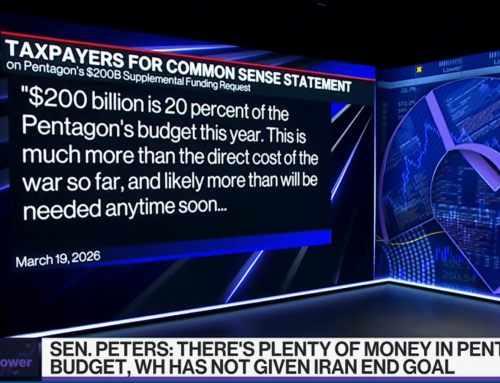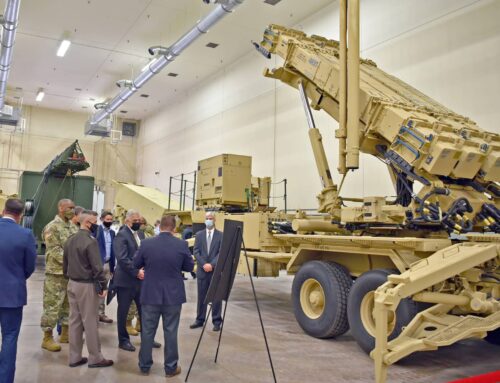

TCS President Steve Ellis and Policy Analyst Gabe Murphy break down President Trump’s Golden Dome missile defense program—an ambitious vision to shield the entire United States from nuclear attack. With potential costs reaching $3.6 to $6 trillion and fundamental technical challenges that make near-perfect interception virtually impossible, Golden Dome represents fiscal irresponsibility at a massive scale. Congress has already approved over $24 billion without even seeing a basic architecture for how the system would work. We examine why hitting hundreds of nuclear warheads traveling at 15,600 mph is far more complex than Israel’s Iron Dome, how nuclear explosions could blind the system’s own radars, and why pursuing this program could trigger a dangerous new arms race in space while undermining arms control efforts. Bottom line: if it doesn’t work, don’t fund it.
Transcript
Announcer:
Welcome to Budget Watchdog All Federal, the podcast dedicated to making sense of the budget spending and tax issues facing the nation. Cut through the partisan rhetoric and talking points for the facts about what’s being talked about, bandied about and pushed to Washington, brought to you by taxpayers for common sense. And now the host of Budget Watchdog AF TCS President Steve Ellis.
Steve Ellis:
Welcome to all American taxpayers seeking common sense. You’ve made it to the right place. For 30 years, TCS, that’s taxpayers for common sense, has served as an independent nonpartisan budget watchdog group based in Washington, DC. We believe in fiscal policy for America that is based on facts. We believe in transparency and accountability, because no matter where you are in the political spectrum, no one wants to see their tax dollars wasted. It’s February 2026, and we’re tackling one of the most expensive and controversial Pentagon programs in recent memory, Golden Dome. President Trump’s vision for a comprehensive missile defense shield that would protect the entire United States from nuclear attack. It’s a compelling promise, freedom from the fear of nuclear weapons, but can it actually deliver? And is it worth the price tag? We just released a major report examining these questions. We’re talking potential costs in the trillions, some of which is already out the door.
Last summer, Congress approved more than $24 billion for the system before receiving so much as basic architecture. In other words, how the system would work. Joining me to break down what Golden Dome is, how much it might really cost, and whether it can actually work as TCS policy analyst, Gabe Murphy, lead author of our new report, Missing the Mark: Why Golden Dome is Bad for American Taxpayers.
Gabe Murphy:
Thanks, Steve. Great to be here.
Steve Ellis:
All right, Gabe, let’s start with the basics. What is Golden Dome?
Gabe Murphy:
Well, to be clear, it’s not a literal dome made of gold, though that might actually be less expensive. At this stage, Golden Dome is a little more than a concept. The vision is basically to build a missile defense shield capable of defending the entire United States from all aerial threats and particularly nuclear weapon threats from peer and near peer adversaries. To achieve this, the president outlined a concept for this system and an executive order early last year and instructed the Pentagon to get to work on an architecture.
Steve Ellis:
Golden Dome wasn’t its name at the time though, right?
Gabe Murphy:
Right. When that memo came out, it was actually called The Iron Dome for America. Inspired by Israel’s Iron Dome missile defense system, the president raised the idea of an Iron Dome for America on the campaign trail, an idea that wasn’t really taken seriously at the time. That changed once the memo came out. It outlined an eight-point plan to defend the entire country against “ballistic, hypersonic, advanced cruise missiles, and other next generation aerial threats from peer, near peer, and rogue adversaries.”
Steve Ellis:
But inspiration aside, Iron Dome is really not a great comparison to what Golden Dome aims to achieve. Can you explain to our budget watchdog, AF Faithful, how they’re different?
Gabe Murphy:
Sure. So Israel’s missile defense systems, which include Iron Dome, are designed to defend against short and medium range rockets and missiles armed with conventional munitions. Golden Dome in contrast aims to defend the entire United States against intercontinental ballistic missiles or ICBMs armed with nuclear warheads. Unlike those shorter range missiles, ICBMs actually leave the atmosphere before reentering it in their terminal phase, and they’re also far faster. The warheads we’re talking about here are only about three meters long and they travel at speeds of up to seven kilometers per second. That’s about 15,600 miles per hour.
Steve Ellis:
We’re also talking about defending a lot more land, right, Gabe? I mean, no offense to Israel, but it is a lot smaller in the United States.
Gabe Murphy:
Yeah, that’s an understatement, Steve. Israel’s Iron Dome has to defend an area of about 8,500 square miles. The United States would need to defend some 3.8 million square miles. Put another way, Israel is about 0.2% of the size of the US. Iron Dome might work for New Jersey, which is about the same size, but we’re not protecting from conventional missiles from Canada.
Steve Ellis:
And that gets to the kicker. With Golden Dome, we’re not talking about protection from conventional missiles.
Gabe Murphy:
That’s right. The adversary’s golden dome would be directed against would be China and Russia, and they wouldn’t be sending conventional missiles. So while a 90 plus percent success rate might be sufficient for Israel’s purposes against some of these conventional weapons, when we’re talking about nuclear weapons, really anything short of a hundred percent success is a failure.
Steve Ellis:
So we’re talking about apples and orange seeds here. All right. Turning to cost and schedule, President Trump said Golden Dome would cost about $175 billion and be done in three years. How does that measure up to independent estimates?
Gabe Murphy:
Well, you can forget about three years. We’re already more than a year in and they’ve just started issuing initial development contracts. As for cost, there have been a few independent estimates that I think get us closer to the truth. Last May, the congressional budget office reported that accounting for decreases in the cost of launch services. Deploying a constellation of space-based interceptors could cost up to $542 billion. But as the infomercials say, “But wait, there’s more.” In this case, the more is the cost.
Steve Ellis:
I like the reference. Do tell.
Gabe Murphy:
What many missed in that report is that it was careful to explain that such a system would only be capable of intercepting one or two ICBMs fired by North Korea, and that’s based on North Korea’s technology more than a decade ago. Russia and China each have hundreds of ICBMs, which are more sophisticated than North Koreas. So it was telling that just developing the capability to theoretically intercept one or two less sophisticated ICBMs could still cost over half a trillion dollars. Now, more recently, the American Enterprise Institute, a center right think tank, estimated that a robust approach to Golden Dome would cost $3.6 trillion over 20 years, or 4.4 trillion adjusted for projected inflation.
Steve Ellis:
Yes, that escalated quickly. So they said that for $3.6 trillion, Golden Dome could protect us from nuclear weapons?
Gabe Murphy:
Well, no. They explained that even with that astronomical cost, the system would fall short of achieving 100% effectiveness. Also, in the fine print, the AEI report explains that a robust approach to certain systems could cost far more. For example, it found that a robust approach to boost phase based-based interceptors, which is where you try and take out ICBMs before they first leave the atmosphere, would cost over $6 trillion. So as others have said before me, the sky isn’t even the limit here. Literally.
Steve Ellis:
All right. Let’s talk about some of the viability problems we examined in our report. What are some of the biggest issues that led to our conclusion that Golden Dome cannot deliver on its promise of defending against ICBMs?
Gabe Murphy:
Well, we already explained one of the central issues, which is dealing with how fast these missiles travel. In a House of Dynamite, a Netflix movie that came out late last year, a fictional deputy national security advisor aptly characterized the challenge as akin to hitting a bullet with a bullet. But because any nuclear attack would most likely involve a salvo of ICBMs, the challenge is more like hitting potentially hundreds of bullets with hundreds of
Steve Ellis:
Other bullets. I may be dating myself, but hitting a bullet with a bullet was how the President George W. Bush era ground-based missile defense was also described. Spoiler alert, that system didn’t work either.
Gabe Murphy:
Right. I mean, the ratios of interceptors to missiles launched is also a major issue. It creates a cost-effectiveness problem right out of the gate. For boost phase intercepts where we would target ICBMs before they leave the atmosphere, the American Physical Society, that’s the main scientific organization dealing with physics.
Steve Ellis:
Got it. It’s not about trying to get Americans to get physicals.
Gabe Murphy:
Yeah, Steve, try and keep up. Anyway, the American Physical Society found that defending the entire United States could require as many as 1600 interceptors in orbit for each missile fired. So defending against a salvo of ICBMs in their boost phase could require putting hundreds of thousands of interceptors in space. That’s why AEI found that a robust approach to boost phase defenses could cost over $6 trillion. Now, the ratios are a little lower for mid-course interceptors, where you try and target warheads in space after they separate from their boosters, but there are other problems with the mid-course approach.
Steve Ellis:
Such as?
Gabe Murphy:
For one, boosters can be designed to break apart into pieces. And in the vacuum of space, they could travel along the same trajectory as the warheads, which means missile defenses would need to be able to differentiate that debris from the warheads themselves or fire enough interceptors to target each object. ICBMs can also carry countermeasures, which can jam radars, mimic the appearance of warheads, disguise warheads in larger objects, or even maneuver when they get close to interceptors.
Steve Ellis:
Wow. That is a lot to overcome, but this still is America, right? I mean, look at what technological ingenuity has achieved in the past. Couldn’t the latest tech figure out some of these solutions to the problems?
Gabe Murphy:
I haven’t seen any workable solutions, but even if they could one day exist, there’s another viability issue that I don’t think anyone has an answer for. Let’s say Russia fires five ICPMs at the US in an opening salvo. Probably an unlikely scenario is they would probably fire many more. Then let’s say we successfully intercept each warhead. One possible result of a successful intercept is a nuclear detonation in space. Even a single nuclear explosion could effectively blind missile defense radar as to an area hundreds of miles wide, which could make it impossible to intercept additional missiles launched in a follow-on salvo. Moreover, warheads can be programmed to detonate upon coming into close enough proximity to an interceptor. So an adversary could render our missile defenses moot pretty easily, even if we spent three or $6 trillion to get all the best equipment up in space.
Steve Ellis:
Well, these viability problems alone should be enough to put the kibosh on this program, but just to be thorough, we also examined some of the potential strategic risks involved with pursuing and deploying Golden Dome. Could you walk us through some of those, Gabe?
Gabe Murphy:
Yeah. The biggest issue is one that’s inherent really to any strategic missile defense system. Pursuing defenses against nuclear weapons is inherently destabilizing. It incentivizes adversaries to expand their nuclear weapons arsenals and capabilities in order to maintain the delicate balance of power that exists between nuclear armed nations. In other words, even if we deployed enough interceptors to achieve a theoretical capability to intercept a full scale nuclear attack, Russia and China could just build more nuclear weapons at a far lower cost, and trillions of dollars later we’re back to square one.
Steve Ellis:
Or they could attack before the defensive system is functioning instead of waiting until their offensive weapons are obsolete.
Gabe Murphy:
Yeah, that’s a real fear too. Also, Steve, with space-based interceptors, there’s a concern that adversaries will view them as weapons. Interceptors are effectively missiles themselves after all and can be used as anti-satellite weapons or potentially even for conventional strikes. Deploying potentially hundreds of thousands of interceptors in space would very likely lead Russia and China to deploy their own space-based weapons as well, if they haven’t already. In the event of a conflict, suddenly space is also a battlefield, which could have devastating consequences for our day-to-day lives, given how much we depend on satellites.
Steve Ellis:
Yikes. Is that it?
Gabe Murphy:
Not quite. Another strategic risk is that pursuing and deploying this system could undermine prospects for the only approach that has ever reliably reduced the nuclear threat. That’s arms control. The last arms control agreement between the United States and Russia just expired. But looking ahead, there are real opportunities to pursue verifiable arms control agreements with Russia and China that could lower the temperature, reduce the nuclear threat, and prevent a new space-based arms race. That all becomes a lot harder to achieve if we press ahead with this program.
Steve Ellis:
So what should Congress do with all of this?
Gabe Murphy:
They should start by pumping the brakes. Congress shouldn’t send another dime out the door without at least reviewing and assessing the feasibility of the program’s architecture. Lawmakers should also challenge the program to demonstrate if it can work. I mean, currently the Missile Defense Agency tests most of its own systems, and those tests have been chronically manufactured for apparent success at an issue we address in the report.
Steve Ellis:
Again, we’ve seen this before. The tests are set up so that the systems know what and where the offensive weapons are coming from, and even with that rigged result, there were failures.
Gabe Murphy:
Yeah. I mean, the GMD system only has a success rate, a nominal success rate of about 60%, which is not very encouraging, and that’s with manufactured test results. So Congress should mandate independent testing with realistic test conditions and set clear performance benchmarks that must be met prior to Golden Dome systems moving out of the lab and into the field.
Steve Ellis:
Gabe Murphy, great work on this report, and thanks for walking us all through it.
Gabe Murphy:
Happy to do it, Steve. Thanks for having me.
Steve Ellis:
Well, there you have it podcast listeners, Golden Dome may prove to be a gilded money pit. It represents one of the most significant budget decisions Congress will make in the coming years, potentially trillions of dollars for a system that won’t achieve its stated goal of reliably defending the United States against nuclear armed adversaries. Our recommendations are straightforward. Implement realistic testing requirements, establish performance benchmarks before deployment funding, review the architecture before appropriating more money, and get independent feasibility assessments. Basic fiscal responsibility when talking about programs that could cost trillions. One of TCS’s guiding principles, if it doesn’t work, don’t fund it. You can find our full report, Missing the Mark: Why Golden Dome is Bad for American Taxpayers at Taxpayer.net. This is the frequency. Mark it on your dial, subscribe and share, and know this. Taxpayers for Common Sense has your back America. We read the bills, monitor the earmarks, and highlight those wasteful programs that poorly spend our money and shift long-term risk to taxpayers.
We’ll be back with a new episode soon. I hope you’ll meet us right here to learn more.