
Congress appropriated $49.1 billion to the Department of Energy for FY2026, a 2% decrease from the previous two years ($50.17 billion in FY2025 and $50.25 billion in FY2024). The cut for DOE energy programs—all non-defense activities—was even greater, down 13% from FY2025. Final appropriations were also significantly higher than the President’s Budget request, which proposed $47.7 billion for DOE and just $12.9 billion for energy programs.
While most energy program offices saw budget cuts, the Office of Energy Efficiency and Renewable Energy (EERE)—the primary vehicle for renewable energy research and development—bore the brunt of it, with a $1.5 billion decrease in funding accounting for nearly half of its FY2025 budget. Additional funding redirected from previously appropriated funds from the Infrastructure Investment and Jobs Act (IIJA)—more on this below—softened the blow, bringing the EERE total to $3.1 billion, a 10% decrease compared to FY2025. Wind and solar offices under EERE faced the largest cuts—a 27% and 31% decrease respectively. The second largest office funding cut was just a $300 million decrease for the Office of Fossil Energy (FE, formerly known as Fossil Energy and Carbon Management, or FECM), with redirected IIJA funding providing another $140 million for FY2026.
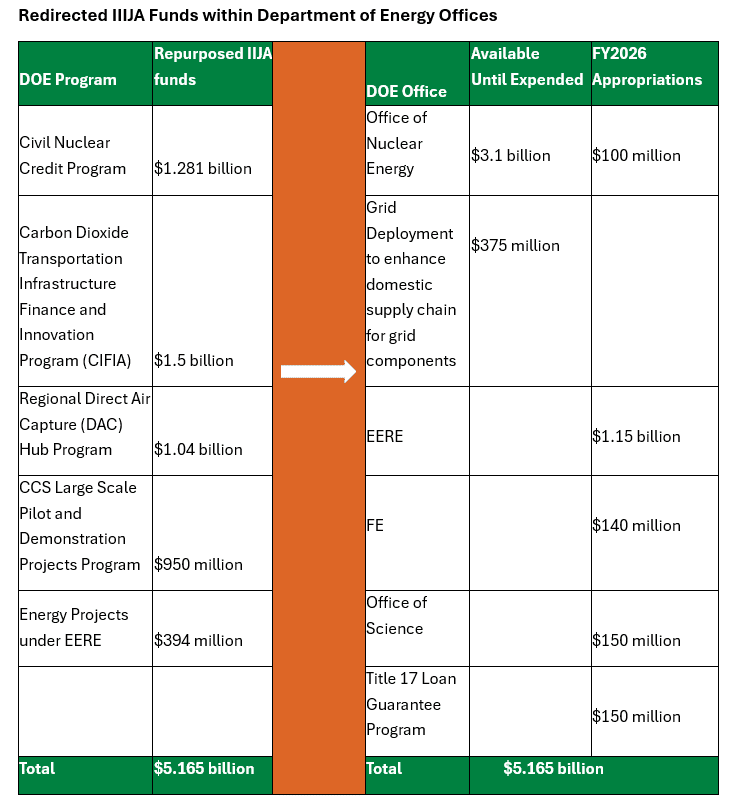
While Congress only appropriated $15 billion in FY2026 funding for DOE energy programs, it also reallocated nearly $5.2 billion in previously appropriated funding from the Infrastructure Investment and Jobs Act (IIJA), instead of rescinding some of this funding as Congress initially proposed. This funding—drawn from remaining funds for the Civil Nuclear Credit, carbon capture and storage (CCS) programs like Direct Air Capture (DAC) hubs, and renewable energy projects—was mostly shifted to the Office of Nuclear Energy, which received $3.1 billion of the IIJA funds. But some funding—around $375 million—also went to Grid Deployment, which will remain available until expended. The remaining amounts of the repurposed funds went to generally support other offices in FY2026, such as EERE and FE, as mentioned above.
Instead of saving taxpayer money by rescinding funds for wasteful programs like the Civil Nuclear Credit, CCS demonstration projects, and DAC hubs that have failed to provide demonstratable results or bring any meaningful benefits, Congress circumvented sound budget practices and redirected these funds to Nuclear Energy projects that have already been heavily subsidized and still fail to be commercially viable.
A detailed breakdown of redirected IIJA funding is included below:
A detailed breakdown of FY2026 appropriations by DOE offices is included below:
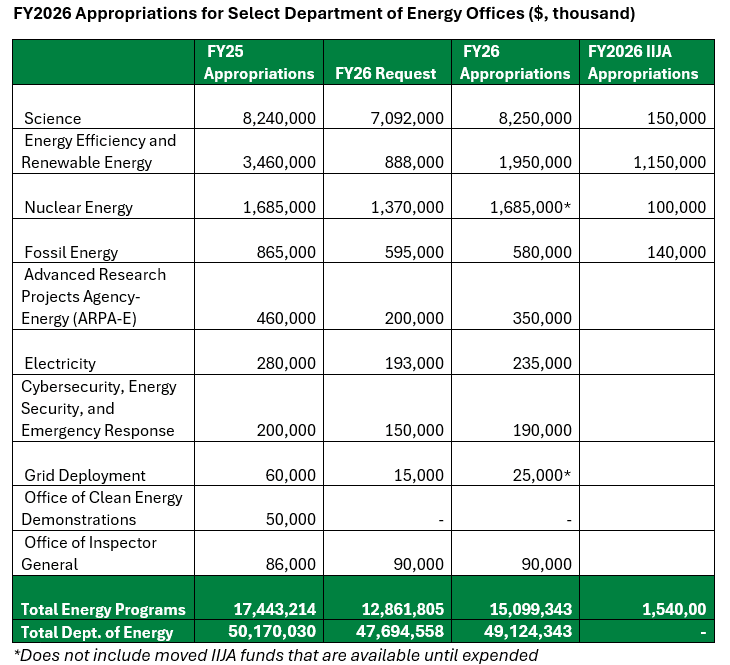
Science: The Office of Science is the largest federal supporter of basic research in the physical sciences, with grants and contracts supporting over 22,000 researchers. Science continues to dominate the DOE energy budget, accounting for nearly 20% of total appropriations. This is one of the few offices Congress increased funding, and final appropriations are higher than the Administration’s request. Re-purposed funding from IIJA programs brings the Science FY2026 total to $8.4 billion. Nuclear research received the largest boost with a $62 million budget increase, nearly the same amount cut from laboratory infrastructure.
Energy Efficiency and Renewable Energy (EERE): EERE funds research and development on “affordable, secure, innovative, and integrated energy technology solutions across multiple sectors of the economy.” Congress appropriated $1.95 billion to EERE, a 44% decrease from last year, although repurposed IIJA funding brings the FY2026 total to $3.1 billion, which is still a 10% decrease from last year. Final appropriations are also more than double the Administration’s request of just $888 million.
All EERE programs saw funding cuts. The only subprograms to receive increases in funding were Water Power (+10%), Geothermal (+27%), and Weatherization (+1%). Wind and Solar, housed under the Renewable Energy Program, had originally been slated for elimination under the President’s Budget Request but were funded by Congress—albeit at a 30% reduction.
Nuclear Energy: Congress appropriated $1.7 billion to the Office of Nuclear Energy, maintaining base funded at the same level as the last two years. As mentioned above, Congress redirected $3.1 billion from IIJA and funneled the funds towards Advanced Reactor Deployment Program and for up to two awards for the development of Gen3+ Small Modular Reactors, available until expended.
Fossil Energy: The Office of Fossil Energy, formerly known as the Office of Fossil Energy and Carbon Management, advances technologies related to fossil fuels, including coal, oil, gas, CCS, and critical minerals. Congress appropriated $580 million to Fossil Energy, a 33% decrease from last year, with repurposed IIJA funding bringing the FY2026 total to $720 million, still a 17% decrease from last year.
Final appropriations include new program names—most of which were proposed in the President’s Budget Request—that reflect the federal government’s shifting priorities towards coal, oil, and gas. For example:
- “Carbon Management Technologies” is renamed “Coal and Carbon Utilization”
- “Resource Sustainability” is renamed “Oil, Gas, and Critical Minerals.”
- “Advanced Remediation Technologies’ is renamed “Advanced Production technologies”
- “Natural Gas Decarbonization and Hydrogen Technologies” is renamed “Natural Gas Infrastructure and Hydrogen technologies”
- “Mineral Sustainability” is renamed “Mineral Production and Processing Technologies”
Advanced Research Projects Agency-Energy (ARPA-E): The ARPA-E was established in 2007 to promote “revolutionary advances in energy,” with a focus on early-stage energy research and development for projects to early or too risky for private sector support. Congress appropriated $350 million to ARPA-A, a 24% decrease from last year.
Grid Deployment: The Office of Grid Deployment was created in 2022 to oversee electric infrastructure. The President’s Budget Request sough to shift Grid Deployment activities to the Office of Electricity. Congress appropriated $25 million to Grid Deployment, a 58% decrease from last year.
Office of Clean Energy Development (OCED): The Department of Energy created the Office of Clean Energy Demonstrations in 2021 to manage $27 billion in funding for clean energy projects. As of November 2025, OCED had committed over $18 billion to about 100 projects. Congress eliminated the OCED and directed DOE to provide quarterly briefings and reports on the redistribution of previous project funding, including the status of previously obligated funds and plans for unobligated funds.