

On March 27, 2026, the Environmental Protection Agency (EPA) announced final 2026 and 2027 volumes for the Renewable Fuel Standard (RFS), requiring record levels of corn and soybean-based biofuels to be blended into the nation’s fuel supply—adding pressure to food and fuel costs at a time when Americans are already facing higher prices.
The RFS mandates that transportation fuel sold in the U.S. contain minimum volumes of ethanol, biodiesel, and other qualifying biofuels. Fuel suppliers—refiners and importers—can comply either by blending the required volumes or by purchasing tradable credits (called RINs) from other parties that exceed their blending targets.
The program originally required 7.5 billion gallons (BG) of renewable fuels to be blended into U.S. transportation fuel by 2012. That target was later expanded to 9 BG by 2008 and ramped up to 36 BG by 2022. However, due to persistent shortfalls in production and consumption, EPA has regularly reduced the congressionally-set targets to lower, final Renewable Volume Obligations (RVOs). Beginning in 2023, EPA has had full authority to set these volumes.
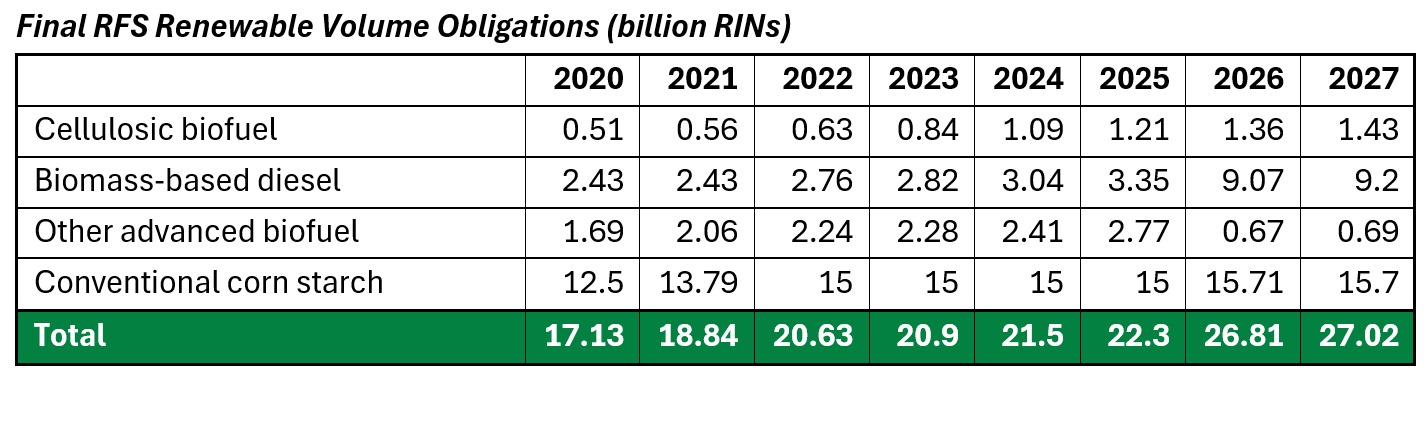
The final 2026-2027 volumes are record high. Total renewable” fuel blending requirements rise from 22.33 billion RINs in 2025 to 25.82 billion in 2026 and 25.98 billion in 2027. Biomass-based diesel nearly doubles from 2025 levels, increasing to 8.86 billion RINs in 2026 and 8.95 billion in 2027. At the same time, the reallocation of RIN that were waived for small refiners in previous years, share of the RFS likely to be filled by conventional ethanol exceeds the statutory maximum set by Congress.
These final RFS volumes will increase costs for both taxpayers and consumers. The biofuels industry has consistently failed to meet the levels envisioned by Congress—particularly for cellulosic biofuel, which is produced from non-food feedstocks like cellulose, hemicellulose, or lignin. Instead, the RFS has been dominated by corn ethanol, driving up food prices, fuel prices, and other taxpayer costs through overlapping federal subsidies.
The RFS distorts the fuel market by picking winners and losers at taxpayers’ expense. In a competitive market, the most efficient and cost-effective solutions would prevail. Instead, government intervention has forced increased biofuel production and consumption. The EPA estimates that the 2026-2027 RFS will increase total renewable fuel supply by 41.9 billion gallons over the next two years. Within that total, corn ethanol supply is projected to increase by 475 million gallons and soy biodiesel by 1.35 billion gallons. The EPA also estimates that, without the RFS, there would be no production of soybean oil or canola oil renewable diesel. In other words, the entire market—projected to reach 4.86 billion gallons in 2026 and 2027—exists solely because of the mandate.
This artificial demand for corn ethanol diverts crops from food to fuel, increasing prices across the grocery aisle. The 2026-2027 volumes are expected to raise the price of corn by $0.03 per bushel. Soybean oil—used for biodiesel and as a primary ingredient in vegetable oils—is expected to increase by $0.28 to $0.35 per pound.
These cost increases cascade through the broader food system. Competing crops grown on the same farmland will also see price increases. For example, oats and barley are expected to rise by $0.02 per bushel. Distillers grains, used as animal feed, are projected to increase by $0.90 to $0.99 per ton, affecting the cost of meat, dairy, and other animal products.
The RFS is also expected to increase fuel prices. EPA estimates that gasoline will be $0.05 per gallon higher and diesel $0.20 to $0.22 per gallon higher under the program in 2026 and 2027. Because most goods in the U.S.—about 65 percent—are transported by diesel-powered trucks, these increases translate into roughly a 1.5 percent price increase for transported goods.
Not only does the government create a mandated market through the RFS, it also subsidizes biofuel production — so higher mandated volumes directly lead to more expensive subsidy programs and greater taxpayer costs. In its analysis of the 2026–2027 RFS volumes, EPA assumes the 45Z clean fuel production credit will provide between $0.14 and $0.62 per gallon for various corn-, soy-, and canola-based fuels covered by the mandate. As noted above, much of this fuel will be produced solely because of the RFS, with projected supply in 2026 and 2027 exceeding what would be produced under EPA’s “No RFS Baseline.” Assuming all eligible fuels qualify for the 45Z credit, TCS estimates the RFS will contribute more than $3 billion in 45Z payouts over the next two years. While these are estimates, the takeaway is clear: current federal biofuel subsidies, combined with higher RFS volumes, will cost American taxpayers billions.

The Renewable Fuel Standard has raised food and fuel prices, distorted agricultural markets, and created long-term environmental liabilities. At the same time, a wide range of federal supports—tax credits, subsidies, and loan guarantees—have funneled billions of dollars to mature corn ethanol and soy biodiesel industries. The record-high 2026-2027 volumes will only deepen these trends, increasing costs for American taxpayers and consumers.
- Photo by liza sigareva: https://www.pexels.com/photo/colorful-fuel-pumps-at-a-gas-station-31161427/