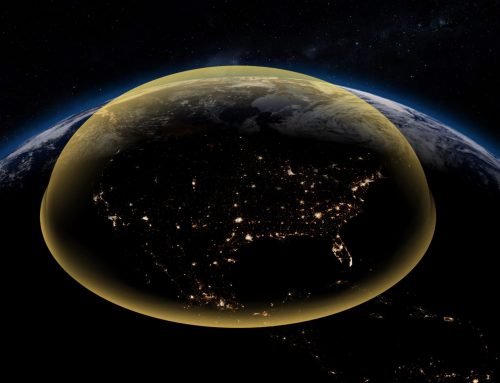

“Three years… $175 billion… all aerial threats.” The president told the nation he would build an impenetrable missile defense shield called Golden Dome for America in that timeframe, at that cost, to defend against, well, everything that travels through the air. While the Pentagon is saying the program will now cost $185 billion, as we highlighted in our recent report on Golden Dome, independent analyses have found that an expansive approach could cost $3.6 trillion over the next two decades, or $4.4 trillion when adjusting for inflation.
According to the Pentagon, they’re still on track to deliver Golden Dome, but it won’t be impenetrable… In the budget request, the Pentagon is tempering expectations:
The goal is to not create a ‘perfect’ defense, but to provide an increasingly effective shield that enhances the U.S. capability to deter attacks, disincentivize arms racing, and negotiate from a position of strength.
Setting aside the absurd assertion that Golden Dome disincentivizes arms racing (it does the opposite), this is a public admission, in writing, that Golden Dome will never be capable of reliably defending the United States from nuclear weapons, because anything short of perfect when it comes to intercepting nuclear weapons cannot be considered a reliable defense. If even one nuclear weapon got through our defenses, the results would be catastrophic. But chances are many would get through in the event of a full-scale attack.
Another hidden headline buried in the tombs of the budget request is the cost. The request seeks about $17.1 billion for Golden Dome through reconciliation, and another $398 million in discretionary funding for a “Golden Dome for America Fund,” which some outlets have understandably characterized as the discretionary budget request for Golden Dome. But if you look beneath the headers and summaries, there are also separate discretionary funding requests for existing missile defense programs that could be part of Golden Dome.
In Research, Development, Test & Evaluation (RDT&E), the budget requests $1.36 billion for Ballistic Missile Defense Midcourse Defense Segment, $865 million Ballistic Missile Defense Sensors, $1.46 billion for BMD Enabling Programs, $1.74 billion for Special Programs – MDA, $927 million for AEGIS BMD, $1 billion for Ballistic Missile Defense Test… the list goes on.
If any of these systems are part of the Golden Dome architecture (most probably are), these funding requests could be considered part of Golden Dome. One could argue that these existing programs would have received funding regardless of Golden Dome, but many of the appropriations requests shot up compared to prior years, sometimes dramatically. While upticks in procurement funding are also included in the budget request, they may be related to the Iran War and the depletion of interceptors. Upticks in RDT&E funding are harder to dismiss as unrelated to Golden Dome.
Here’s a partial list of Defense-Wide RDT&E funding for missile defense, detailing growth in spending from FY2026 enacted levels to the FY2027 request. This list is not comprehensive.

Across these ten program elements (there are many other programs related to missile defense, some of which have less growth), discretionary spending would jump from around $3.8 billion to $8.7 billion, a growth rate of 127 percent, and a cost increase of about $4.9 billion.
In other words, while the budget request makes it look like the president is only requesting about $17.5 billion for Golden Dome, a decrease from last year, that number may be billions of dollars short of the truth. It’s possible the budget actually seeks an increase compared to FY2026, though without the architecture for Golden Dome, it’s impossible to know.
For FY2028 and beyond, Congress has instructed the Pentagon to submit a budget justification volume dedicated to Golden Dome funding. Until then, a precise accounting of the costs of Golden Dome is about as achievable as building a missile defense shield capable of reliably defending the United States from nuclear weapons.