
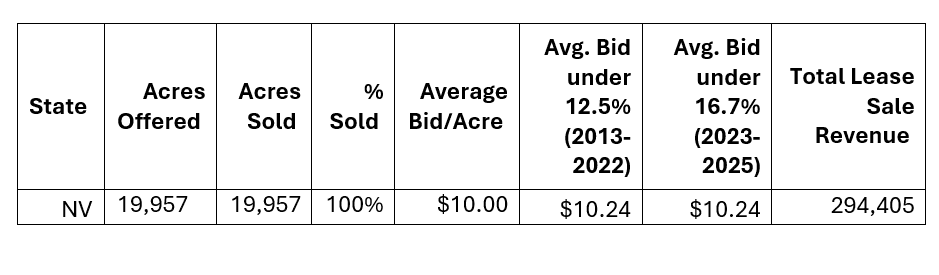
On March 31, the federal government offered and leased 19,957 acres of public land in Nevada for oil and gas development at the recently reduced federal royalty rate of 12.5%. All 11 leases were acquired by a single entity at the legal minimum bid of $10 per acre.
Federal oil and gas leasing in Nevada has not been a lucrative investment for taxpayers. Over the last decade, the Bureau of Land Management (BLM) has leased nearly a quarter million acres of public land in Nevada for oil and gas development at public auctions, often at rock bottom prices, with only a fraction ever entering production. Unfortunately for taxpayers, today’s auction is unlikely to be an exception.
Results from today’s lease sale:
Today’s results, while disappointing for taxpayers, are unsurprising. BLM evaluated all 11 parcels as a low preference for leasing. Seven out of 11 parcels were judged to have low potential for oil and gas development, and all have low proximity to existing development. BLM estimates that while 19 wells may be drilled on the leased parcels, only one well is likely to ever enter production.
Leasing decisions are driven by development potential and market conditions. Nevada is not a major federal oil and gas producer. Over the last decade, it accounted for less than one-tenth of one percent of federal oil production nationwide and an even smaller percentage of federal gas production. Only 5.7% of federal land leased for oil and gas development in Nevada is currently producing.
The lower royalty rate did not make these leases more competitive. The sale’s average bid of $10 per acre is on par with historical leasing trends in the state—both for leases offered at a 12.5% royalty rate and more recent leases offered at the 16.67% royalty rate. But while little oil and gas production is expected from the newly issued leases, the lower royalty rate will reduce any future royalty revenue—leaving thousands of dollars on the table that would have been shared between federal taxpayers and Nevadans.
Oil and gasoline prices are set on global markets, so the war with Iran and related supply risks have pushed crude prices higher, causing consumers to pay more at the pump and on their utility bills. Updating onshore leasing policies would not change how gasoline prices are set, but it would ensure a better return for taxpayers on the production of publicly owned oil and gas.
Federal oil and gas belongs to the American people, and leasing terms should ensure taxpayers receive a fair return from the development of our valuable resources. Offering and leasing public land that is unlikely to ever produce oil and gas is a waste of our tax dollars and our public lands.