
This week, the House and Senate Armed Services Committees (HASC & SASC) held hearings on the Trump Administration’s $1.5 trillion Pentagon budget request. Lawmakers took the opportunity to ask some important, pointed questions. What they didn’t ask said a lot, too.
Towering Topline
The Pentagon is requesting a $1.5 trillion budget for FY2027, including $1.15 trillion through the Pentagon’s base budget, and an additional $350 billion through budget reconciliation. Together, that would mean a roughly 45 percent increase over this year’s enacted level—and the largest U.S. military budget in real, inflation-adjusted dollars in our nation’s history. It’s larger than the military budget at the height of World War II. And this request comes on the heels of an 18 percent—or roughly $160 billion—increase this year.
In light of these circumstances, one might expect that members of the House and Senate Armed Services Committees would have taken the opportunity of a budget hearing to question the need for another Pentagon budget hike or the risks associated with enacting one. Most did not.
SASC Ranking Member Jack Reed (D-RI) was one of the exceptions. As he framed it, “you appear before us to ask for a $1.5 trillion budget, a 45 percent increase above last year. I must say, I’m skeptical, and such a request demands intense scrutiny.” We couldn’t agree more. Later on, however, he bemoaned that “this budget slashes research and development, provides no funding for Ukraine, and includes no funding for losses incurred from the Iran War.”
It’s unclear what cut to research and development he may have been referencing. The budget request seeks $343 billion for Research, Development, Test & Evaluation (RDT&E), up from $210 billion in FY2026. That’s a 63 percent increase. Even if you exclude reconciliation, this year’s discretionary RDT&E request of $218 billion is up $8 billion from the FY2026 grand total (including reconciliation), and $73 billion from the FY2026 discretionary total alone.
HASC Ranking Member Adam Smith (D-WA) also challenged the topline increase. In his opening remarks, he offered his concern over the nation’s nearly $40 trillion debt, and argued that we “have to have a national security strategy that lives within a sound fiscal picture.” He also questioned whether the military can effectively absorb another $500-600 billion, and said that “we need to pay as much attention to how we’re spending the money as to how much we’re spending, and we never seem to do that.” That’s the right idea. But he also said, “I hear the Chairman on the need for an increased budget,” begging the question of just how much of an increase the Ranking Member and the rest of the minority are prepared to support.
While the Pentagon plans to secure $350 billion of the increase through a reconciliation package, it’s requesting some $250 billion of its budget increase through the regular budget process. Unlike reconciliation, which can pass on party lines by a simple majority vote in both chambers, passing regular appropriations generally requires some bipartisan support.
Rep. Austin Scott (R-GA) raised concerns about this dynamic during the hearing:
I just, I mean, it takes 218 votes to get something across the floor of the House of Representatives. And with NDAA and with budget plus ups and everything else… we’re going to have to have some Dem votes to do the things that we have to do to fund the Department of Defense. And I just, I would encourage everybody to keep that in mind, because we’re going to lose some Republican votes on the plus-up.
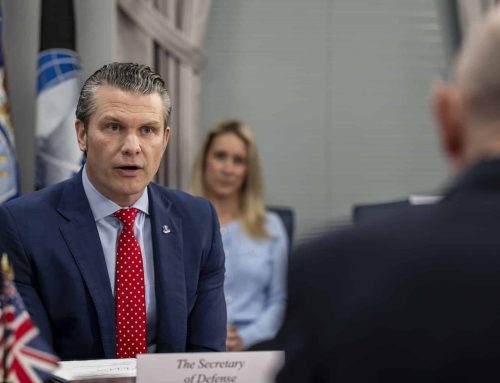
We certainly hope that last prediction pans out. His comments followed some heated exchanges between Secretary of Defense Pete Hegseth and Democrats on the committee, and foreshadowed a debate that hasn’t transpired in public just yet. Democrats appear united against the notion of another partisan reconciliation splurge for the Pentagon, and many have spoken out against the $1.5 trillion request. But where will they land on the Pentagon’s request for a $250 billion increase in its base budget, where their vote could actually make a difference? There’s been little, if any, public discussion so far from lawmakers on this critical question. For our part, we’d urge lawmakers on both sides of the aisle to reject any increase for the Pentagon in the wake of a $160 billion increase this year.
Reconciliation Regards
Wherever one lands on the wisdom or recklessness of a 45 percent Pentagon spending increase in a single year, there are important process questions to consider.
Rep. Ronny Jackson (R-TX) offered one on the risks involved with pursuing $350 billion of the Pentagon’s budget request through reconciliation. His question was specifically about the risks to the Defense Autonomous Warfare Group (DAWG), an effort focused on developing autonomous drones that the budget request would fund mostly through reconciliation. As he put it, “I remain concerned about the potential gaps created if such a package fails to occur… how is the department planning to fully fund DAWG at the $54.6 billion if reconciliation stalls, or if the department, or does the department intend to transition funds for autonomous requirements into the base budget for future years?”
Secretary Hegseth’s response was that “we plan to work hand in glove with this committee, with OMB, with the White House, to ensure that that reconciliation package is properly tailored and timed so that it is passed…” In case you missed it, he didn’t answer the question of what happens if reconciliation fails, which, as Rep. Jackson’s concern suggests, is a distinct possibility.
During the Pentagon’s press briefing on its budget request last week, Ashley Roque of Breaking Defense asked the Pentagon Comptroller what risk the Pentagon is assuming by putting high priority funding in reconciliation, and after citing the perceived benefits of reconciliation, he explained that “if we’re not successful in getting a reconciliation bill passed, then we’ll revisit that with the White House and Congress to achieve our budget request.”
Last year, lawmakers passed reconciliation prior to most of the annual appropriations bills for FY2026. The one exception was the Department of Homeland Security (DHS) funding bill, which Congress finally passed this week after advancing a second round of reconciliation to fund Immigration and Customs Enforcement (ICE) and Customs and Border Protection (CBP). If Republican lawmakers aim to pass what would be this Congress’ third reconciliation bill to fund $350 billion of the Pentagon’s budget request, it may or may not attempt this before Congress passes regular appropriations for the Pentagon. If it comes after, and then fails to pass, some of the worthwhile projects that reconciliation would have funded, like addressing quality of life issues in military barracks, will either go underfunded or will require a separate funding vehicle to enact.
By requesting reconciliation funding for programs that would likely have received bipartisan support if requested through the regular budget process, the Pentagon may be trying to ensure that if Republicans fail to pass reconciliation, lawmakers on both sides of the aisle will feel pressured to increase the Pentagon’s base budget above the $1.15 trillion requested through regular appropriations. So, it appears a goal of this funding distribution, in lieu of ensuring the timely appropriation of necessary funding, is ensuring as high of an increase in the Pentagon budget as possible.
Moreover, if another round of Pentagon spending through reconciliation does pass, it may not be obligated as efficiently or thoughtfully as it would be if funding for the same projects was passed through the normal budget process. In the Pentagon’s spending plan for the first round of reconciliation, which was released more than six months late, and which did not entirely adhere to congressional intent, the Pentagon laid out its intention to expend all of the money appropriated by the end of FY2026. Adhering to that plan would mean spending an additional $38.2 billion above what the Trump Administration requested for FY26 through reconciliation, and above what Congress thought it was enacting for FY2026 when it passed reconciliation and the Pentagon’s annual appropriations bill.
While the spending plan illustrated a desire to spend money as quickly as possible, that goal isn’t going as planned. In the SASC budget hearing, Chairman Roger Wicker (R-MS) asked, “how much of the $154 billion from reconciliation has the Pentagon put on contract?” Secretary Hegseth replied that, “the number you’re looking for is about, what I’m looking at, about $26 billion right now, but we’ve got the floodgates about to open and applied to those priorities.” In other words, seven months into the fiscal year, the Pentagon has only obligated about 17 percent of its funding from the One Big Beautiful Bill Act (OBBBA), but plans to obligate the remaining 83 percent, roughly $128 billion, in the next five months.
So, to recap, the Pentagon is rushing to spend more money than Congress intended to enact for this fiscal year to help make the case that Congress should appropriate even more money for the Pentagon in the coming fiscal year.
Warrantless Wars
While the topline and the policy and process shortcomings of reconciliation received relatively little attention in these hearings, far more attention was given to the unauthorized war in Iran.
In the HASC hearing, Ranking Member Smith asked the Pentagon Comptroller Jules Hurst about the costs of the war so far, and to his surprise, he received an answer. Mr. Hurst replied that, “approximately, at this day we’re spending about $25 billion on Operation Epic Fury. Most of that is in munitions; there’s part of that that’s obviously O&M and equipment replacement. We will formulate a supplemental through the White House that will come to Congress once we have a full assessment of the cost of the conflict.”
Multiple lawmakers expressed doubts that this was in fact a complete accounting of costs, and experts on the cost of war have challenged the estimate in the media as well. Rep. Ro Khanna (D-CA) asked if that total included the cost of buying, in today’s dollars, new weapons and replacements, and covering the cost of damage to facilities. Secretary Hegseth replied that “if there’s adjustments to that, I would, I would defer to the comptroller on that.”
In the SASC hearing the following day, Sen. Richard Blumenthal (D-CT) raised the issue of healthcare for servicemembers wounded during the war, and asked, “does that $25 billion estimate include all of the costs in terms of damage to our bases, the need to replace planes and munitions, and the costs of injuries to our service men and women?” The entirety of Mr. Hurst’s response was that “for the MILCON facilities replacement cost, that’s probably the hardest thing to estimate right now because we don’t know what our future posture is going to be, or the future construction of those bases.” Not only did this response fail to address the cost of caring for wounded servicemembers—it also suggests that the Pentagon may not have included any facilities replacement costs in its calculations. That said, his response does pose a question worth asking; whether we should in fact continue to maintain such a large military footprint in the region, given the obvious vulnerability of our bases and the risks to troops stationed at them.
Earlier this week, the American Enterprise Institute estimated the cost of rebuilding or repairing damaged bases in the Middle East at $5 billion. Sen. Blumenthal, for his part, concluded that “I think $25 billion is probably less than half, maybe less than a quarter of the total cost of war, which is the reason why the supplemental request is much higher, so I think you owe it to the American people to give us the straight talk about what the costs have been.”
Sen. Tim Kaine (D-VA), asked about the president’s plans for the war in light of constraints on the unauthorized use of military force enshrined in the War Powers Resolution:
To Secretary Hegseth and General Caine, the War Powers Resolution specifies that a war initiated by a president without congressional approval must be concluded within 60 days. It can be extended by an additional 30 days if ‘the president determines and certifies to Congress in writing that unavoidable military necessity respecting the safety of the U.S. armed forces requires the continued use of such armed forces in the course of bringing about a prompt removal of such forces.’ We’re right at the 60-day deadline. Is the president intending to either seek congressional authorization for the war in Iran, or send us the legally required certification that he needs an additional 30 days to remove U.S. forces from the war?
Secretary Hegseth response was that “ultimately I would defer to the White House and White House Counsel on that, however we are in a ceasefire right now, which our understanding means the 60-day clock pauses or stops in a ceasefire.” Sen. Kaine retorted, saying, “I do not believe the statute would support that.” The fact that U.S. forces are still engaged in a military blockade did not come up, and the question of how this creative reading of the War Powers Resolution would play out if fighting resumes was neither asked nor answered.
There were also questions about the war’s objectives, strategies and human costs. These questions went largely unanswered as the discussions frequently devolved into rhetorical posturing and partisan attacks. Lawmakers also posed a series of questions on the unauthorized use of military force in Venezuela to capture former Venezuelan President Nicolas Maduro, and in the Caribbean to target vessels allegedly smuggling drugs. Similarly, these serious questions were not met with substantive answers.
Superfluous Systems
Within a $1.5 trillion budget request, you would expect some questions from lawmakers about the merits of funding for specific programs. And there were some, just not as many as we would have liked.
Rep. Jared Golden (D-ME) took aim at the rush to build a new Trump-class battleship, highlighting the risks of concurrent development and production:
Perhaps what’s most troubling to me is that the battleship plan proposes moving at a pace that is I think extremely dangerous, or just high-risk, low reward. To begin construction so quickly, breezing right through design—it’s well documented that expediting design and preemptively moving to construction is the greatest recipe for failure. This represents an unacceptable cost to taxpayers if it fails, and leaves America less secure, and our Navy less prepared.
Sen. Mark Kelly (D-AZ) also expressed concerns over the strategy underlying investments in specific systems, like the F-47 and the B-21, the Air Force’s next-generation fighter and bomber:
Do we want, you know, F-47 which I’ve been supportive of, B-21 also supportive. And then we want to make all these other investments in really inexpensive, low cost, munitions, because we suddenly realize that the expensive stuff, even with through B-21 we can’t really, maybe not get close enough. But the whole idea behind B-21 and F-47 is we can penetrate further into the A2D2 bubble. So, there’s some conflict there.
A2D2 stands for Anti-Access/Area Denial, and refers to the ability to deny an adversary access to enter and operate freely in certain areas. So essentially, Sen. Kelly was questioning whether the B-21 and F-47, systems that are heavily funded in this budget and could ultimately cost taxpayers trillions of dollars over their lifecycles, are actually going to be capable of operating deep in near-peer enemy territory in the event of a war. We share the senator’s concerns over the strategic rationale for these systems, and commend him for raising these concerns in spite of his former support for the programs. We also hope he will seek to address these concerns by proposing cuts to these programs during the committee’s markup of the National Defense Authorization Act, which is expected to occur in the second week of June.
Sen. Kelly, a former astronaut, also offered the only meaningful critique of Golden Dome in either hearing, saying, “I know a little bit about intercepting stuff in space. It’s really hard, and the physics on this favors the offense. There’s some things in that program that I think is really important that we do and try to figure it, figure it out, but space-based interceptors to hit multiple targets…” We agree that space-based interceptors are a terrible idea.
Other questions on Golden Dome were less informative. Sen. Patty Murray (D-WA) asked Chairman of the Joint Chiefs of Staff Gen. Daniel Caine to “give us your thoughts on why the Golden Dome received, why they must receive that requested $17 billion in funding for the Fiscal Year 27.” He replied that it’s an “essential part of our homeland security layer defense,” to which Sen. Murray said, “We appreciate the help, and if there’s a delay in that funding…” Gen. Caine interjected and said he hopes there isn’t.
Big Picture
Despite Secretary Hegseth’s outlandish claim during one of the hearings that “this is a fiscally responsible budget,” true fiscal conservatives, and really anyone with a basic grasp of addition and subtraction, know better. In our view, lawmakers on both sides of the aisle have room for improvement, to put it diplomatically, when it comes to scrutinizing this gargantuan budget request. That means drilling down on the specifics—not just rhetorically opposing the $1.5 trillion overall topline, but questioning the $1.15 trillion base budget request, which alone represents a $250 billion increase over last year’s base budget. It means scrutinizing the process, and the risks of budgeting for national security through reconciliation. And it means drilling down on a programmatic basis, examining the justifications for each of the specific increases that comprise the roughly $500 billion overall spending boost. Absent that, we fear that taxpayers may be asked to pay for the most expensive military budget in history at the expense of our nation’s fiscal health, and ultimately, national security.