
Established by an Executive Order in 1999, the Bioenergy Program for Advanced Biofuels (BPAB) is intended to pay advanced biofuels producers to expand their production levels. Other than corn starch ethanol, nearly every other type of biofuel is eligible for the program, including ethanol, biogas, butanol, or biodiesel derived from cellulose (like perennial grasses or agricultural residues), sugar or starches, waste materials, sugarcane, or woody biomass. BPAB is administered by the U.S. Department of Agriculture’s (USDA) Rural Development office. The 2012 farm bill provided $300 million in mandatory program funding for BPAB from FY09-12, with opportunity for additional funding through annual appropriations bills. The 2008 farm bill expired Sept. 30, 2012, so a one-year retroactive extension passed as part of the Jan. 2013 “fiscal cliff” deal allowed farm bill programs, including BPAB, to be funded through September 30, 2013 (the end of FY13). The 2014 farm bill energy title, enacted in February, provided significantly less mandatory funding of $15 million for each Fiscal Year 2014-18 and discretionary (optional) funding of $20 million annually.
Background
BPAB is funded though the energy title of the farm bill. The farm bill, renewed approximately every five years, is a wide ranging piece of legislation that funds everything from nutrition assistance programs and broadband internet to agricultural subsidies for the production of crops such as corn and soybeans. More specifically, the energy title of the farm bill, first introduced in 2002, provides grants, loans, and other subsidies to energy efficiency, biofuels, and bioenergy (heat and power) projects. In total, the 2014 farm bill energy title’s programs are projected to cost taxpayers $879 million over the next ten years (FY14-23).
In particular, BPAB provides taxpayer subsidies to a range of facilities to increase annual production of biofuels. Other farm bill energy title programs provide taxpayer support for research and development grants to investigate new uses for biomass sources such as wood and agricultural residues; the collection, storage, harvest, and transportation of biomass sources to bioenergy or biofuels facilities; anaerobic digesters that create heat and power from animal waste; grants and loans to individuals or companies wind, solar, and geothermal systems; and federally backed loan guarantees for so-called next generation biofuels facilities that produce biofuels other than corn ethanol.
While intended to support the next generation of biofuels derived from non-food sources and other renewable forms of energy, the farm bill energy title has also spent taxpayer dollars on the mature corn ethanol industry, supporting biomass sources with numerous unintended consequences, and even paying for updates to farmers’ irrigation equipment and grain dryers.
Feedstocks Receiving Taxpayer Funding
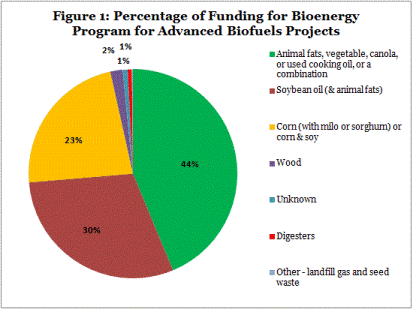
Over $261 million were dispensed from 2009 to March 2014 through the BPAB program via spending authorized in the 2008 farm bill. Figure 1 and Table 1 illustrate which types of feedstocks received the most taxpayer subsidies over this timeframe. Together, soy biodiesel and corn ethanol facilities were awarded over half of all BPAB funding. Facilities converting animal fats, canola oil, vegetable oil, used cooking oil, or a combination of these received another 44 percent of funding. Those feedstocks or technologies collecting the few remaining dollars include wood pellets, seed waste, landfill gas, and anaerobic digesters.
|
Table 1: Types of Feedstocks Subsidized in Bioenergy Program for Advanced Biofuels, 2009 – 2014 |
|||||
|---|---|---|---|---|---|
| Types of Feedstocks | Number of Projects |
Pct. of Projects | Total Payment | Pct. of Total |
Ave. Pmt. per Project |
| Animal fats, vegetable, canola, or used cooking oil, or a combination | 98 | 32% | $114,205,453 | 44% | $1,165,362 |
| Soybean oil (& animal fats) | 32 | 10% | $78,120,843 | 30% | $2,441,276 |
| Corn (with milo or sorghum) or corn & soy | 24 | 8% | $59,618,433 | 23% | $2,484,101 |
| Wood | 52 | 17% | $4,984,432 | 2% | $95,854 |
| Unknown | 38 | 12% | $2,053,586 | 1% | $54,042 |
| Anaerobic digester | 62 | 20% | $1,608,492 | 1% | $25,943 |
| Other – seed waste or landfill gas |
3 | 1% | $418,738 | 0.2% | $139,579 |
| Sorghum | 1 | 0.3% | $51,370 | 0.2% | $51,370 |
| TOTAL | 310 | $261,061,347 | |||
Large Corn Biofuels Facilities Receiving Taxpayer Funding
The highest payments per project by far were awarded to large agribusinesses operating corn and soy biofuels facilities. This is despite the fact that corn ethanol facilities are not even eligible for funding through this program or defined as an advanced biofuel in any current federal legislation. Regardless, USDA is still funneling money to this mature industry, in addition to soy biodiesel facilities. From 2009 to 2014, 21 corn ethanol facilities and three corn oil biodiesel facilities received $60 million in federal subsidies, an average of $2.5 million per project. See Table 2 for more information. The corn ethanol industry has already received more than its fair share of federal subsidies over the past 30 years, including energy and commodity subsidies in the farm bill, production tax credits, import tariffs, taxpayer-backed loans, and infrastructure support. In addition, corn ethanol production is mandated through the federal Renewable Fuel Standard (RFS); more specifically, the RFS mandate requires that 15 billion gallons of corn ethanol be used in U.S. motor gasoline by 2015.
|
Table 2: Corn Biofuels Facilities Receiving Advanced Biofuels Payments, 2009-14 |
|||
|---|---|---|---|
| Facility Name (* notes the facility produces biodiesel) | State | Feedstock | Total Payments |
| White Energy Inc | TX | corn/milo | $10,442,369 |
| Arkalon Ethanol LLC | KS | corn/milo | $9,935,595 |
| Western Plains Energy | KS | corn/milo | $8,302,242 |
| Kansas Ethanol LLC | KS | corn/milo | $5,914,342 |
| Pinal Energy LLC | AZ | corn | $4,651,731 |
| Prairie Horizon Agri-Energy LLC | KS | corn/milo | $4,428,160 |
| Levelland/Hockley Co. Ethanol (now Diamond Ethanol) | TX | corn/milo | $3,308,326 |
| Abengoa Bioenergy Corp. | MO | corn/milo | $3,108,385 |
| Bonanza Bioenergy LLC | KS | corn/milo | $3,082,023 |
| Chief Ethanol Fuel Inc | NE | corn/milo | $2,308,795 |
| Reeve Agri Energy Inc | KS | corn/milo | $1,723,906 |
| Nesika Energy LLC | KS | corn | $771,812 |
| Central Indiana Ethanol LLC | IN | corn | $482,973 |
| Corn Plus LP | MN | corn | $311,081 |
| Walsh Bio Fuels, LLC* | WI | corn | $267,030 |
| Trenton Agri Products LLC | KS | corn/milo | $231,620 |
| Nugen Energy LLC | SD | corn | $98,591 |
| East Kansas Agri-Energy LLC | KS | corn | $58,834 |
| Cornhusker Energy Lexington, LLC | NE | corn | $14,871 |
| Chippewa Valley Ethanol Coop | MN | corn | $14,597 |
| Best Biodiesel Cashton, LLC* | WI | corn/soy | $10,487 |
| Kappa Ethanol, LLC | NE | corn | $8,693 |
| Maple River Energy, LLC* | IA | corn/soy | $7,845 |
| TOTAL | $59,618,433 | ||
Large Agribusinesses Receiving Subsidies for Biodiesel Production
Table 3 identifies several large agribusinesses receiving more than $1 million of taxpayer subsidies for biodiesel production. Biodiesel can be produced from corn oil, as noted above, or other feedstocks such as soy or other types of vegetable oil, animal fats, recycled cooking oil, etc. Notable companies receiving taxpayer support from 2009-2013 include the Renewable Energy Group, Louis Dreyfus, Ag Processing, Archer Daniels Midland, MN Soybean Processors, and Cargill Inc. Similar to the generous taxpayer supports corn ethanol has received over the past 30 years, biodiesel companies have also benefited from a $1 per gallon production tax credit for several years, on top of several other federal incentives.
|
Table 3: Biodiesel Facilities Receiving Advanced Biofuels Payments, 2009-14 |
|||
|---|---|---|---|
| Facility Name | State | Feedstock | Total Payment |
| Lake Erie Biofuels, LLC Dba Hero Bx | PA | multi | $16,842,034 |
| Renewable Energy Group, Inc. | IA | canola | $15,308,992 |
| Louis Dreyfus Agricultural Industries | IN | soy | $12,468,872 |
| High Plains Bioenergy, LLC | OK | animal fats | $11,915,721 |
| AG Processing Inc | NE | soy | $11,221,637 |
| Mid-America Biofuels, LLC | MO | soy | $10,530,741 |
| Paseo Cargill Energy, LLC | MO | soy | $9,690,338 |
| Archer Daniels Midland Company | IL, ND | canola | $7,744,279 |
| Deerfield Energy LLC | MO | multi | $6,846,753 |
| MN Soybean Processors | MN | soy | $5,914,635 |
| Owensboro Grain Company, LLC. | KY | soy | $5,668,413 |
| Cargill Inc. | MN | soy | $5,562,689 |
| Smarter Fuel, Inc. | PA | cooking oil | $5,202,080 |
| Incobrasa Industries, Ltd. | IL | soy | $4,897,378 |
| FutureFuels Chemical Company | AR | animal fats/soy | $4,661,016 |
| Imperium Grays Harbor LLC | WA | canola | $3,849,794 |
| Rbf Port Neches, LLC. | TX | multi | $3,710,752 |
| E Biofuels LLC | IN | animal fats/cooking oil | $3,440,667 |
| Western Iowa Energy | IA | multi | $3,020,233 |
| American Biodiesel, Inc | CA | multi | $2,741,786 |
| Crimson Renewable Energy LP | CA | multi | $2,703,216 |
| Western Dubuque Biodiesel, LLC | IA | canola | $2,569,989 |
| Sequential‐Pacific Biodiesel | OR | cooking oil | $2,516,531 |
| Jatrodiesel, Inc. | OH | multi | $2,144,479 |
| Midwest Biodiesel Product, LLC. | IL | soy | $2,011,805 |
| Green Earth Fuels Of Houston, LLC. | TX | multi | $1,924,678 |
| Environmental Energy Recycling Corp. | PA | cooking oil | $1,758,853 |
| Scott Petroleum Corporation | MS | multi | $1,726,854 |
| Imperial Western Products, Inc. | CA | animal fats/veg oil | $1,654,933 |
| Iowa Renewable Energy, LLC | IA | animal fats/veg oil | $1,441,303 |
Other Feedstocks Receiving Taxpayer Subsidies
As Table 1 illustrated, projects receiving the last few million dollars of BPAB payments converted either woody biomass, sorghum, or seed waste into biofuels or used anaerobic digesters or landfill gas to power bioenergy facilities. On average, these payments were three to ten times smaller than the average checks sent to corn ethanol facilities. The remaining projects were filed in the unknown category since too little detail was provided by USDA to determine which types of feedstocks are used in the facilities.
Conclusion
Even though the Bioenergy Program for Advanced Biofuels was intended to spur production of advanced biofuels, as the program’s title suggests, its funding stream reveals a different story. Instead of assisting small, rural residents or small businesses obtain financing to help second-generation biofuels derived from non-food feedstocks get off the ground, the program is instead funneling taxpayer dollars to large, profitable, and well-known agribusinesses. Government funding is also spent on mature biofuels industries like corn ethanol and soy biodiesel, which have enjoyed taxpayer backing for more than 30 years. Now more than ever, taxpayers should not be forced to fund corporate welfare and mature technologies, so the BPAB program must not be renewed in the next farm bill and spending should be reined in until then.
For more information, contact Taxpayers for Common Sense at 202-546-8500.