
The Bureau of Land Management (BLM), within the Department of the Interior (DOI), announced last week that it will hold an oil and gas lease sale in the Arctic National Wildlife Refuge (ANWR) on June 5, 2026. This will be the first of a total of four sales mandated by the One Big Beautiful Bill (OBBBA, P.L. 119-21).
The newly released details of the sale show that BLM plans to offer 58 tracts covering 688,829 acres in this first auction. The minimum bid will be $25 per acre, rent $10 per acre, and royalty rate will be 16.67 percent — the same as what was charged for oil and gas leases in the National Petroleum Reserve in Alaska (NPR-A) and those used in the first of the two sales in ANWR. The second sale included the same minimum bid and royalty rate but a $30/acre rental fee.
Although this is the first sale mandated under OBBBA, it is the third mandated lease sale in the Arctic Refuge. During the first Trump Administration, Congress authorized a federal oil and gas leasing program in the 1.6-million-acre Coastal Plain of the Arctic Refuge. It was included in the 2017 Tax Cuts and Jobs Act, to partially offset the law’s $1.9 trillion price tag. Congress required two lease sales with each offering at least 400,000 acres. The Congressional Budget Office (CBO), Congress’s nonpartisan scorekeeper, estimated those two sales would generate $910 million in federal revenue. But the results were far less.
The first lease sale, held in January 2021, divided the Coastal Plain into 32 tracts and offered 22 tracts totaling 1,089,053 acres. Only 437,804 acres got bid on, generating $16.5 million in revenue—less than 1 percent of what Congress and CBO projected. Only two private companies submitted bids, and both later sought to rescind their leases. The Alaska Industrial Development and Export Authority (AIDEA), a public corporation of the State of Alaska, stepped in due to the lack of industry interest. The second lease sale, held in January 2025, offered 400,000 acres—the congressionally mandated minimum, much of it overlapping with the previous sale. It attracted no bidders and generated no revenue.
Despite these outcomes of these two lease sales, OBBBA again mandates four new oil and gas lease sales in the Refuge: the first within one year of enactment (7/4/2026), the second within three years (7/4/2028), the third within five years (7/4/2030), and the fourth within seven years (7/4/2032). Each must offer no fewer than 400,000 acres — roughly a quarter of the 1.56 million acres open to development. These sales will follow the same terms and conditions established in the 2020 development plan issued by the first Trump administration, which allowed leasing across the entire Coastal Plain with minimal restriction on surface-disturbing activities.
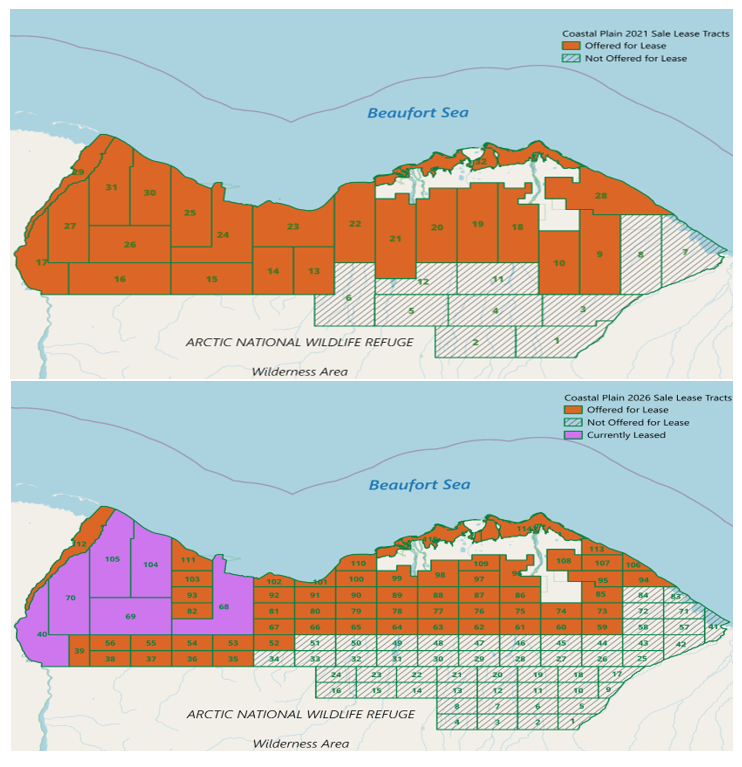
Compared to the 2021 lease sale, the June 2026 sale will divide available acreage into smaller tracts—115 instead of 32—with each new tract roughly a quarter the size of those offered in 2021. Of those 115 tracts, 58 tracts totaling about 688,829 acres will be offered in this sale. As shown in the sale maps above, all acres in this offering were previously offered but not leased in 2021.
CBO has preliminarily estimated that the four mandated lease sales under OBBBA will generate $452 million in federal revenue over ten years (FY2025-2034). While significantly lower than its 2017 estimate of $946 million, these projections are still likely overstated, as the economics of developing the Arctic Refuge have not fundamentally changed. Drilling in a remote and sensitive region with little supporting infrastructure continues to deter both industry and investors.
With the same leasing terms and largely the same tracts as the 2021 sale, this auction may again fall short of what was promised to taxpayers. Based on 20-year average bid levels for state and federal leases on Alaska’s North Slope, TCS projects that—even under favorable conditions—future ANWR lease sales are likely to generate between $3 and $30 million in federal revenue.
Leasing public lands for oil and gas development in a remote and sensitive region is unlikely to meaningfully increase oil supply or lower prices at the pump in the near or long term. Instead, drilling in ANWR would shift administrative costs and environmental liabilities onto taxpayers—affecting outdoor recreationists, hunters, anglers, and the broader public.
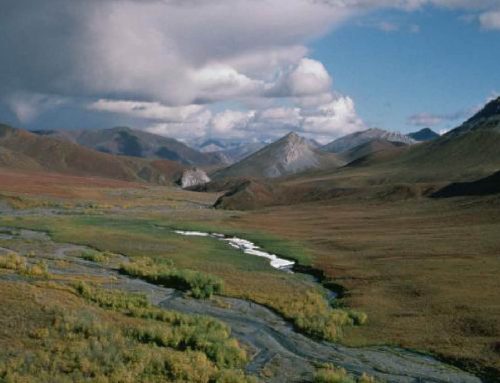
- Courtesy of Protect The Arctic/Florian Schulz